E-Invoicing in Italy
The Italian E-Invoicing Model
Meet Italian e-invoicing obligations and discover how to maintain compliance as you expand into new international markets.


The legal framework for e-invoicing in Italy, set out in Legislative Decree of December 27, 2018, n. 148, Decree of April 3, 2013, n. 55, applies to public authorities and many other entities. B2G e-invoicing is mandatory for all central administrations, based on European Directive 2014/55/EU. The regulations were introduced gradually from 2014, when the obligation to use electronic financial documents rested only on ministries, tax offices and national security agencies. A year later, in 2015, all public entities in the country were obliged to do so. Italy was also the first EU country to make national e-invoicing mandatory for B2B and B2C. The obligation entered into force on 1 January, 2019.
Till December 2027, the European Union Council has granted Italy a derogation for an extension of its mandatory electronic invoicing system.
State of E-Invoicing in Italy
On June 4, 2025, the Council of Ministers approved a legislative decree that modifies tax compliance requirements. This decree introduces a permanent ban on electronic invoicing through the SDI for healthcare services provided to individuals, in order to protect the confidentiality of healthcare data in business-to-consumer (B2C) relationships.
Implementation timeline
 2015
2015- June 2015
Mandatory B2G e-invoicing
-
2019
- July 2019
Mandatory B2B e-invoicing
-
2020
- February 2020
Mandatory B2G goods e-ordering to entities associated in the National Health Fund
-
2022
- June 1, 2022
All cross-border invoices (export, import, intra-community, etc.) are sent to SDI on a transactional basis
- July 1, 2022
- Cross-border e-invoicing became mandatory
- San Marino joined the Italian e-invoicing model
- Enterprises with revenue more than EUR 25,000 are obliged to send electronic invoices to the SDI
-
2024
- January 1, 2024
- Micro enterprises with revenue or fees less than EUR 25,000 will be obliged to send electronic invoices to the SDI

E-invoicing process description
Italy uses the CTC (continuous transaction controls) system for e-invoices. Under the CTC SDI model, companies issue structured invoices in the tax authorities’ XML format, called FatturaPA. In B2G transactions, companies are obliged to issue a qualified electronic signature. This can be done by them or by a service provider. In the public healthcare sector, there is an additional flow of electronic orders via the NSO, which functions in the same way as the SDI.

What is the required format of an e-invoice?
The accepted format is Fattura-PA for accounts payable and accounts receivable. E-invoices must be issued in a prescribed format, signed digitally to guarantee their authenticity and integrity, and then sent to the exchange system called Sistema di Interscambio (SDI) by the taxpayers themselves or through designated intermediaries. The SDI platform is used mainly between public entities to receive, check, and send electronic invoices. Using PEPPOL is also possible.
What is SDI?
SDI (Sistema di Interscambio) is a national Internet hub that provides a portal for sending and receiving e-invoices. All electronic invoices in Italy must be sent to SDI. All e-invoices are sent via SDI to the customer by identifying the buyer's IPA code.
Comarch is compliant with all standards and regulations connected to the SDI process. We have already helped almost 100 customers to be in line with Italian e-invoicing regulations.

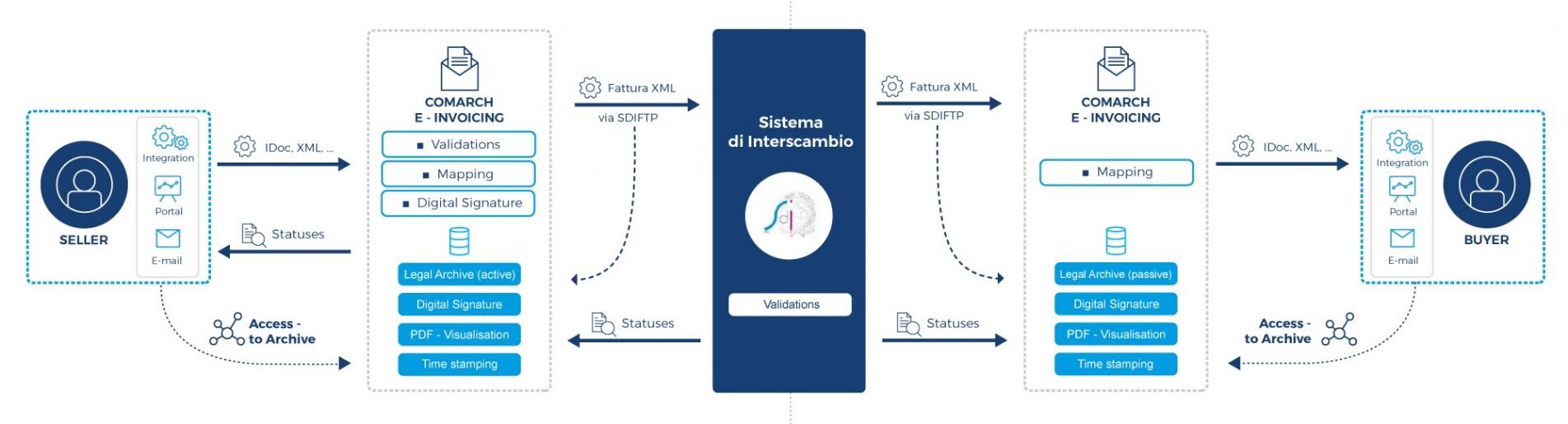
What does the integration of Comarch e-invoicing with SDI look like?

How integrity and authenticity may be ensured?
According to the AGID (Agency of Digital Italy), which enforces e-archiving rules, each company should be able to provide a time stamp and signature, as well as structured, mandatory metadata in an XML readable invoice in PDF format. A documented description of the archive (Manuale dela Conservazione), together with obligations and responsibilities of the archiving process, are implemented.

Penalties
The Italian government is very strict with its e-invoicing system and has applied a set of penalties for users. For the late sending of the electronic invoice to SDI, without consequences on the tax settlement (i.e., with correct periodic VAT settlement), the sanction provided for by art. 6, paragraph 1 of Legislative Decree 471/97 or the amount ranging from Euro 250 to Euro 2,000, for each document not sent or sent late. The deadline for sending the invoice to SDI is 12 days from the date of execution of the operation for immediate invoices and 15 days following the reference month for deferred invoices (with the end-of-month date).
All Italian companies have also been obliged to communicate cross-border invoices. There is an administrative penalty from EUR 2 to EUR 400 for each invoice not communicated correctly. However, the penalty is halved if the invoice is issued and corrected within 15 days.

How can we help?
Comarch provides full coverage in terms of conenctivity to the SDI platform, which is used within the existing CTC mandate. Comarch is able to generate or convert in-house formats to the required FatturaPA format.
Legal regulation changes in Italy


Achieve Global e-Invoicing Compliance with Comarch
-
Unilever
The implementation of electronic data interchange at Unilever -
Leroy Merlin
Comarch Document Management and Exchange Platform for Leroy Merlin -
Agfa
Implementation of Comarch e-Invoicing at Agfa-Gevaert Group -
BIC
Comarch EDI Complex Services for BIC -
Lidl
Comarch e-Invoicing at Lidl -
METRO Digital
Comarch EDI at METRO Digital -
Danone
Benefits of implementing Comarch Electronic Data Interchange -
Kraft Heinz
Comarch Master Data Management (MDM) Project -
ObjetRama
Comarch EDI at ObjetRama -
Volotea
Digitize Billing Processes With Comarch E-Invoicing -
Technicolor
Implementation of Comarch EDI at Technicolor -
Carrefour Poland
Comarch EDI at Carrefour Poland -
Red Bull
Red Bull actively develops business processes by using modern Comarch solutions -
Colgate-Palmolive
Online Distribution and Mobile Sales Force for Colgate-Palmolive -
Balconi
Implementation of Comarch EDI at Balconi -
La Redoute
Implementation of Comarch EDI at La Redoute -
Italcementi
Italcementi and Comarch: Improving business efficiency by digitizing invoicing processes -
Bolsius
Implementation of Comarch EDI solution for Bolsius -
Belmond Group
Belmond Group Chooses Comarch to Update its E-invoicing and E-archiving Systems -
Angelini Holding
Angelini Holding S.p.A Chooses Comarch EDI Platform for its Foreign Branches -
Sammontana
Sammontana Chooses Comarch Master Data Management -
BayWa
BayWa Implements Comarch EDI to Meet the Upcoming B2G E-invoicing Obligation -
Ursus Breweries
Comarch E-invoicing Helps Ursus Breweries Meet New Legal Requirements in Romania -
Heidelberg Materials
Global Digitization with Comarch EDI at Heidelberg Materials -
Monini
Monini chooses Comarch’s EDI platform -
Mutti
chooses Comarch EDI for multi-country data processes -
De Cecco
Comarch EDI at De Cecco -
La Doria
Processes of Electronic Data Interchange in E-commerce