The AI Imperative: 5 Ways AI is Transforming Retail Loyalty Programs
- Published
- 10 min reading
In our first article, we explored the strategic shift needed to start viewing your loyalty program as a revenue engine. The next logical question you probably often hear from business leaders is, “What technology actually makes that possible?”. In our experience, the answer is unequivocal: Artificial Intelligence.
How AI Is Changing Retail Loyalty Programs
AI is no longer a future concept; it’s the core operating system for a profitable, modern loyalty program. Without it, retailers are often just automating old, inefficient strategies. A loyalty program without AI is like a car without an engine – it may look good, but it won't drive profitable growth.
Here are the key areas where we've seen AI completely transform what's possible in retail loyalty:
1. From Generic Segments to AI-Powered Hyper-Personalization
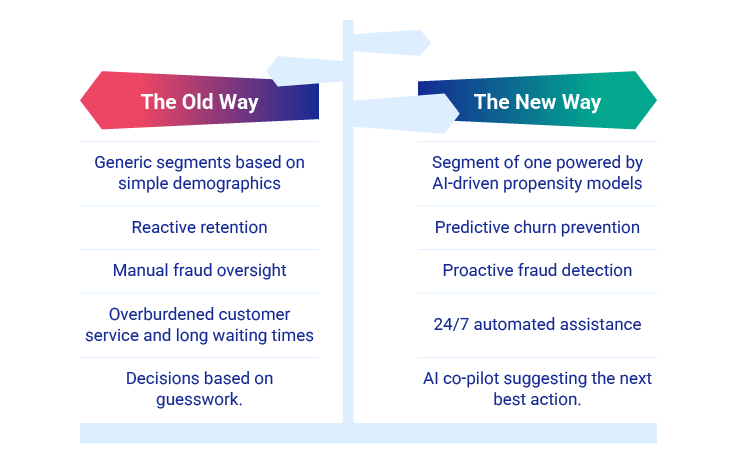
- The Old Way: Manually creating broad customer segments based on simple demographics.
- The New AI Way: AI moves businesses from broad segments to a “segment of one.” It analyzes each customer's real-time behavioral data to build AI-driven propensity models. These models predict the next best action and the optimal offer for every individual, leading to dramatically higher conversion rates. UK retailers like Tesco and Marks & Spencer already excel in using AI to power hyper-personalization. Marks & Spencer leverages customer data to deliver offers and communications aligned with individual shopping habits. Tesco takes it a step further by combining personalized offers with gamified loyalty elements, such as challenges and rewards, tailored to customer behavior – all contributing to increased engagement and higher sales.
Programs are migrating from a traditional general reward basket approach to a customized list of rewards to be redeemed, much more oriented to an individual’s desire, using AI not only to predict the next best offer, but also to reward a customer with the right products and services. – Luiz Felipe Paveloski Caper, Business Director at Comarch LATAM
2. From Reactive Retention to Predictive Churn Prevention
- The Old Way: Reacting after a customer has already stopped spending, when winning them back is expensive and often impossible.
- The New AI Way: In our work with clients, we've found that AI-powered churn prediction models act as a crucial early warning system. They identify the subtle changes in behavior that signal a customer is at risk, allowing you to intervene proactively with a targeted retention offer before they're gone.
3. From Manual Oversight to Proactive Fraud Detection
- The Old Way: Manually reviewing spreadsheets and investigating fraud long after the financial damage has been done.
- The New AI Way: A pattern we consistently observe is the effectiveness of AI and machine learning as a 24/7 security guard. These algorithms monitor transactions in real-time to identify and flag anomalous patterns, shifting your security posture from reactive to proactive and protecting your bottom line.
4. From Static Support to 24/7 Automated Assistance
- The Old Way: Overburdened customer service teams answering the same simple questions repeatedly.
- The New AI Way: AI-powered chatbots can handle routine queries like balance inquiries or FAQs instantly. This frees up call center agents to address complex customer issues more efficiently and with greater attention, improving overall customer satisfaction.
5. From Manual Management to an AI Strategy Co-Pilot
- The Old Way: Loyalty managers spending their days buried in spreadsheets, using guesswork to plan campaigns.
- The New AI Way: An AI co-pilot, like our own MAIA (My Artificial Intelligence Assistant), acts as a strategic partner for a loyalty manager. It continuously analyzes program data to provide proactive insights and campaign recommendations, empowering your team to make more informed, strategic decisions and dramatically improving the effectiveness of your entire loyalty operation.
A Successful Retail Loyalty Program Is an AI Program
AI enables a shift from reactive to proactive, from generic to personal, and from manual to automated. For retailers, this is the fundamental difference between running a loyalty program that costs money and one that makes money.
Now that we've established why AI is the non-negotiable engine for a modern loyalty program, the final step is to build a comprehensive business case to secure the internal investment. In our next and final article, you’ll get a proven framework to help you do just that.