What is Cloud Cost Management? Benefits, Challenges, and Best Practices

According to a 2024 McKinsey survey, over 95% of European companies already consider their cloud programs a top priority, and more than one-third discuss progress at the executive level. Yet with 77% relying on managed services, the question isn’t whether the cloud matters—it’s how to manage its costs effectively. Cloud cost management has become a boardroom issue, ensuring investments deliver measurable returns rather than unpredictable bills.
This article will help you:
- Discover what cloud cost management really is and why it matters at the executive level
- Understand the hidden culprits driving cloud overspend
- Learn practical strategies to cut costs without limiting innovation
- Explore best practices and tools to embed cost optimization into daily operations
- See how advanced approaches shape the future of cloud cost management
What is Cloud Cost Management?
Cloud cost management is the practice of monitoring, analyzing, and optimizing cloud spending. It helps businesses control costs, improve resource efficiency, and maximize ROI across public, private, and hybrid cloud environments.
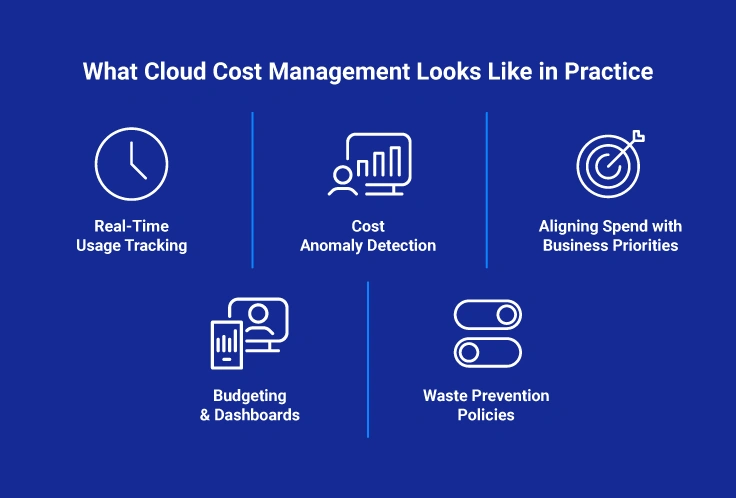
In practice, cloud cost management involves:
- Tracking resource usage in real time
- Spotting cost anomalies
- Aligning cloud spend with business priorities
- Setting budgets, using dashboards to visualize expenses
- Applying policies to avoid waste, such as automatically shutting down idle instances
Effective cloud cost management turns cloud costs from unpredictable bills into controlled, data-driven investments, ensuring every dollar spent supports business growth and innovation across public, private, and hybrid cloud environments.
Why Effective Cloud Cost Management is Crucial for Your Business

Managing cloud spend is the top challenge organizations face, with 84% of enterprise-size companies identifying it as a key concern. For businesses running complex, multi-service cloud environments, unmanaged spend can erode margins and constrain innovation. But effective cloud cost management transforms the cloud from an unpredictable expense into a strategic asset.
- Maximizing ROI – Cloud investments should directly support business objectives. Cloud cost management ensures workloads run on the most cost-efficient configurations, eliminating waste and reallocating cost savings to high-value initiatives.
49% of business leaders say that measuring the true value of cloud investments remains a major barrier to realizing full ROI.
- Improving Budget Forecasting – Inconsistent or opaque cloud billing undermines financial planning. Cloud cost management introduces cost transparency through granular usage data, enabling CFOs and budget owners to forecast with confidence and prevent overruns before they occur.
- Driving Operational Efficiency – Cloud cost management uncovers underutilized resources, redundant services, and inefficient configurations. Automated policies can decommission idle instances or shift workloads to lower-cost tiers, ensuring teams deliver more with fewer resources.
- Enabling Innovation Without Overspend – By controlling baseline costs, cloud cost management frees up budget for experimentation without financial risk.
The Hidden Culprits: Common Cloud Cost Challenges
Did you know that over 20% of organizations admit they lack clear visibility into how cloud spending maps to specific business activities?
Even with clear goals, many companies discover that managing cloud spend is more complex than anticipated. In our experience auditing diverse client environments we consistently find that costs don’t explode overnight. They spiral quietly, obscured by the sheer scale and pace of cloud consumption.
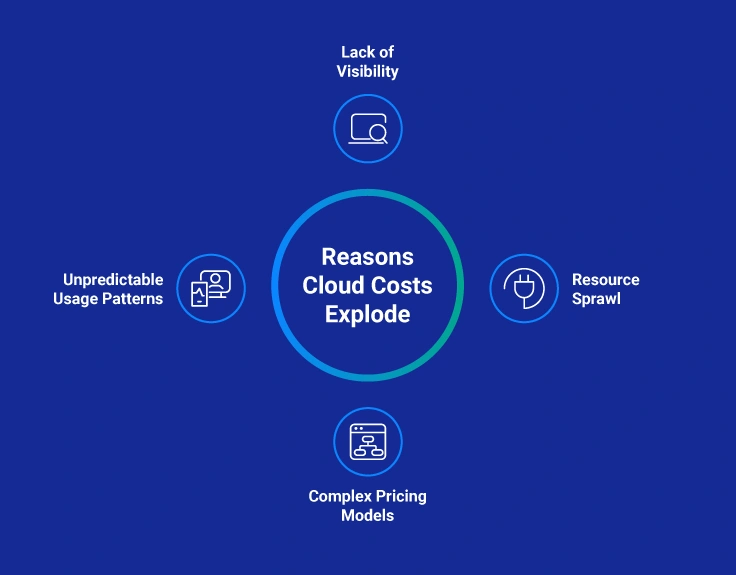
- Lack of Visibility – Without unified reporting, cloud bills become a maze of line items spread across services, regions, and accounts. This makes it difficult for leadership to understand where money is going—or why.
- Resource Sprawl – Development teams often spin up resources for testing or short-term projects and forget to decommission them. These “zombie” instances silently accumulate charges over time.
- Complex Pricing Models – Public cloud providers offer multiple pricing tiers, discount programs, and usage-based fees. Without specialist oversight, it’s easy to choose suboptimal options that inflate total spend. This is why many enterprises choose to outsource billing analysis to cloud specialists.
- Unpredictable Usage Patterns – Seasonal demand spikes, experimental workloads, or unexpected data transfer costs can quickly disrupt even the most disciplined budgets.
These challenges actually affect margins, hinder innovation, and limit your organization’s ability to scale. Recognizing these patterns is the first step toward regaining control and turning cloud investments into predictable, value-driven assets.
Understanding Your Bill: Main Factors Driving Cloud Costs
For many enterprises, the first real challenge in cloud cost management is deciphering the monthly invoice. Cloud providers bill with precision, but the complexity of services, tiers, and consumption patterns makes understanding the drivers of spend a discipline in itself.
Core Cost Drivers
- Compute – Charges for virtual machines, containers, or serverless functions, typically billed by usage time and configuration size.
- Storage – Fees for object, block, or file storage, influenced by capacity, redundancy level, and access frequency.
- Data Transfer – Costs for moving data within or between regions, and especially between the cloud and on-premises environments. Often underestimated, these can spike during migrations or heavy integrations.
Common Pricing Models
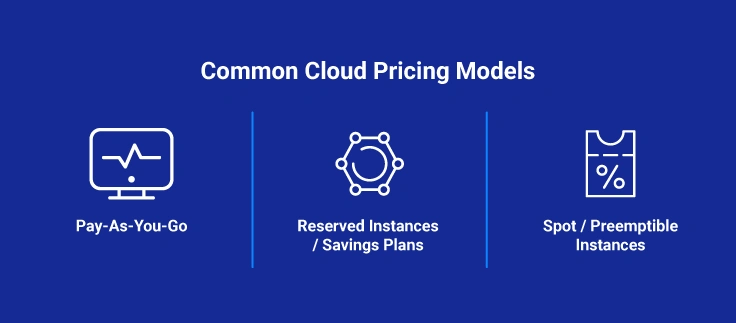
- Pay-As-You-Go – Flexible and immediate, but can be costly if workloads aren’t optimized for continuous use.
- Reserved Instances or Savings Plans – Commit to a specific capacity or usage pattern over one to three years in exchange for significant discounts.
- Spot or Preemptible Instances – Access unused capacity at a fraction of the price, ideal for non-critical or fault-tolerant workloads.
Without a grasp of these foundational elements, it’s easy to mistake symptoms like higher-than-expected bills for root causes.
Your Blueprint for Savings: 7 Actionable Cloud Cost Management Strategies
A McKinsey analysis of more than $3 billion in combined cloud spending across industries revealed that most organizations still had 10–20% in untapped savings. Our own optimization projects at Comarch confirm this data. By applying the strategies below, we have helped partners reclaim substantial budget percentages that were previously lost to inefficiency.
Note: While these strategies are effective, they require constant vigilance. Many organizations find that partnering with a managed service provider to handle routine rightsizing and policy enforcement yields better long-term results than trying to manage it solely with stretched in-house resources.
How can you do it?
1.Right-Size Your Resources
Continuously evaluate your compute and storage configurations to ensure they match actual workload needs. Oversized virtual machines or overprovisioned storage tiers quietly inflate costs. Use monitoring tools to track utilization and downsize underused assets.
2. Leverage Reserved and Savings Plans
For predictable workloads, commit to Reserved Instances or Savings Plans with your cloud provider. These options can deliver cost reductions compared to on-demand pricing. Align commitments with long-term project timelines and ensure procurement and technical teams collaborate before purchase to avoid overcommitment.
3. Automate Resource Scheduling
Idle resources outside business hours are a common source of waste. Implement automated schedules to power down development, testing, and non-critical workloads when not in use. Policy-driven automation tools can enforce this consistently across accounts, reducing unnecessary runtime charges without relying on manual intervention.
4. Optimize Storage Tiers
Not all data requires high-performance storage. Classify data based on access frequency and move rarely accessed files to lower-cost tiers, such as cold or archival storage.
5. Monitor and Control Data Transfer Costs
Data egress—especially across regions or between cloud and on-premises systems—can be a silent budget killer. Map data flows, consolidate workloads to reduce cross-region transfers, and use caching or CDNs where appropriate. Proactive monitoring prevents unexpected spikes during high-volume operations.
6. Implement Tagging and Cost Allocation
Establish a standardized tagging framework to attribute cloud costs to specific teams, projects, or business units to create accountability, enable granular reporting, and facilitate more accurate budget forecasting. Tagging also simplifies identifying underutilized or redundant resources for decommissioning.
7. Use Continuous Cost Monitoring and Alerts
Deploy real-time monitoring and set budget thresholds with automated alerts. This allows rapid response to anomalies (such as runaway workloads or unexpected service activations) before they cause significant overruns.
Essential Cloud Cost Management Best Practices – Checklist

☐ Audit Regularly – Review resource usage, billing data, and cost trends monthly.
☐ Right-Size Resources – Match capacity to workload demand; avoid overprovisioning.
☐ Leverage Committed Discounts – Use Reserved Instances or Savings Plans for steady workloads.
☐ Automate Idle Shutdowns – Schedule off-hours power-down for non-critical environments.
☐ Adopt Tiered Storage – Store infrequently accessed data in lower-cost tiers.
☐ Tag Consistently – Apply standardized tags for cost allocation and accountability.
☐ Monitor Data Transfer – Track and reduce cross-region or cloud-to-on-prem egress.
☐ Set Budgets and Alerts – Automate notifications for spend thresholds and anomalies.
☐ Integrate Cloud Cost Management into FinOps – Align cost management with finance and operations processes.
☐ Educate Teams – Ensure all stakeholders understand cost implications of cloud usage.
Choosing Your Toolkit: An Introduction to Cloud Cost Management Tools
The right cloud cost management tool transforms raw billing data into actionable insights, enabling finance, IT, and operations leaders to make data-driven decisions. When selecting a cloud cost management solution, align the tech with your governance model, compliance needs, and growth strategy.
Key Features to Look For:
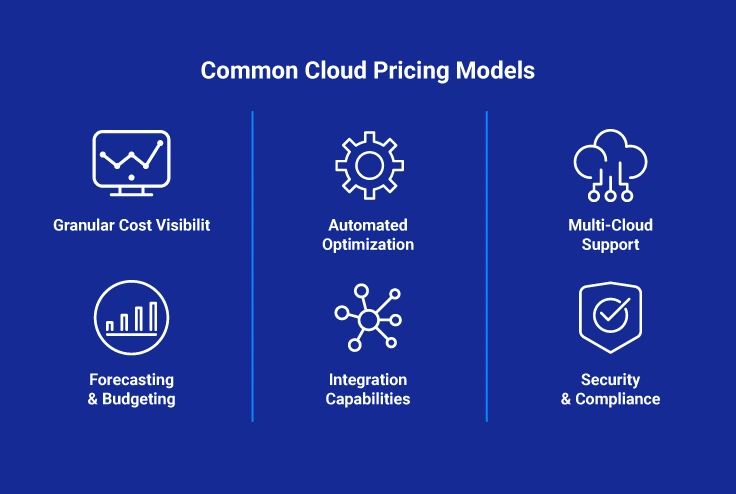
- Granular Cost Visibility – Detailed breakdowns by service, region, and business unit.
- Automated Optimization – Rightsizing recommendations, idle resource detection, and policy enforcement.
- Multi-Cloud Support – Unified view and control across AWS, Azure, GCP, or hybrid environments.
- Forecasting & Budgeting – Predictive analytics to support accurate financial planning.
- Integration Capabilities – Ability to connect with ERP, ITSM, or BI platforms for streamlined reporting.
- Security & Compliance – Built-in controls for regulatory adherence and sensitive data handling.
Categories of Cloud Computing Cost Management Tools
- Native Provider Tools – Integrated solutions from cloud vendors (e.g., AWS Cost Explorer, Azure Cost Management) offering direct access to usage and billing data. Best for organizations operating primarily within a single cloud.
- Third-Party Platforms – Vendor-neutral tools that aggregate and analyze spend across multiple providers. Ideal for enterprises with multi-cloud or hybrid cloud environments requiring centralized governance.
- Custom & In-House Solutions – Tailored frameworks built internally or in collaboration with a service partner, offering maximum control and alignment with unique business processes.
The Future of Savings: Advanced Cloud Cost Management Techniques

As cloud adoption matures, cost optimization becomes a proactive, intelligence-driven discipline. The next wave of cloud cost management blends advanced tooling, cultural change, and architectural strategies.
- The FinOps framework unites finance, operations, and engineering teams under shared cost accountability. However, building a FinOps culture from scratch takes time. To accelerate this maturity, forward-thinking leaders often engage external experts to establish the initial governance frameworks. By embedding cost awareness into development cycles and governance processes, you can turn cloud cost management into an ongoing practice rather than an afterthought.
- AI-driven analytics identify usage trends, predict future spend, and even recommend workload rebalancing before costs spike. Machine learning models continuously refine predictions based on real consumption patterns, enabling finance leaders to budget with greater accuracy and avoid surprises.
- Enterprises increasingly leverage multiple cloud providers for resilience, performance, and regulatory compliance. Advanced cloud cost management tools and strategies enable dynamic workload placement without compromising availability or cloud data security.
- Beyond alerts, modern systems enforce cost policies automatically. Idle resource shutdowns, storage tier adjustments, and compliance guardrails happen without human intervention, allowing teams to focus on core business and innovation.
Key Takeaways on Cloud Cost Optimization
- Cloud cost management is essential for turning cloud spend into a strategic investment.
- Effective cloud cost management improves ROI, budgeting accuracy, and operational efficiency.
- Common challenges include lack of visibility, resource sprawl, and complex pricing models.
- Understanding cost drivers (compute, storage, and data transfer) is critical for optimization.
- Proven strategies include rightsizing, automation, storage tiering, and real-time monitoring.
- A clear tagging framework and budget alerts enhance accountability.
- The right cloud cost management tool depends on your environment: single-cloud, multi-cloud, or hybrid.
- Advanced techniques like FinOps, AI forecasting, and multi-cloud strategy optimization are influencing the future of cloud cost management.
Cloud Cost Management: Solution for Sustainable Growth
Technologically, cloud cost management is the bridge between workloads and innovation. AI-driven forecasting, automated remediation, and multi-cloud orchestration are non-negotiable. For executives, cloud cost management also links cloud spending to measurable business outcomes. Organizations that invest now are building scalable, adaptable architectures capable of meeting future demands without runaway costs.
Ultimately, cloud cost management is about clarity: knowing where every euro or dollar goes and ensuring it fuels growth, not inefficiency. Comarch brings decades of ICT experience and deep cloud expertise to the table, helping you cut through the noise.
Our specialists won’t waste your time with sales pitches or buzzwords. Instead, you’ll get straightforward, practical advice tailored to your environment and challenges. So, stop wondering. Schedule your consultation today. A non-binding call is often enough to uncover hidden cost drivers and identify immediate opportunities for cost savings.