IT Outsourcing for the Manufacturing Industry
Manufacturing companies rely heavily on complex IT systems to support production, automation, and supply chain operations. However, maintaining in-house IT teams capable of managing this complexity, while also meeting demands for innovation, uptime, and cybersecurity, is increasingly challenging. It’s no surprise that 42% of industrial manufacturers already rely on IT outsourcing for automation control systems, simulation software, and analytics tools. Outsourcing enables manufacturers to reduce operational burdens, access specialized expertise, and scale their IT capabilities in line with production needs.
In this article, you’ll find out:
- Why many manufacturers are turning to IT outsourcing
- How manufacturing companies can benefit from outsourcing IT services
- What industry trends are driving the shift toward external IT partnerships
What Is IT Outsourcing for the Manufacturing Industry?
IT outsourcing refers to delegating part or all of a company’s IT operations, services, or infrastructure to an external provider. This can include day-to-day system administration, data center management, application support, cybersecurity, cloud hosting, or integration of operational technology with enterprise systems.
Manufacturing companies can outsource functions such as:
- Infrastructure management (servers, networks, storage)
- Cloud hosting and migration (including hybrid and multi-cloud setups)
- Cybersecurity and compliance services
- Helpdesk and end-user support
- Development and maintenance of factory software, IoT platforms, or data analytics tools
Strategic Reasons to Outsource IT Services and Infrastructure
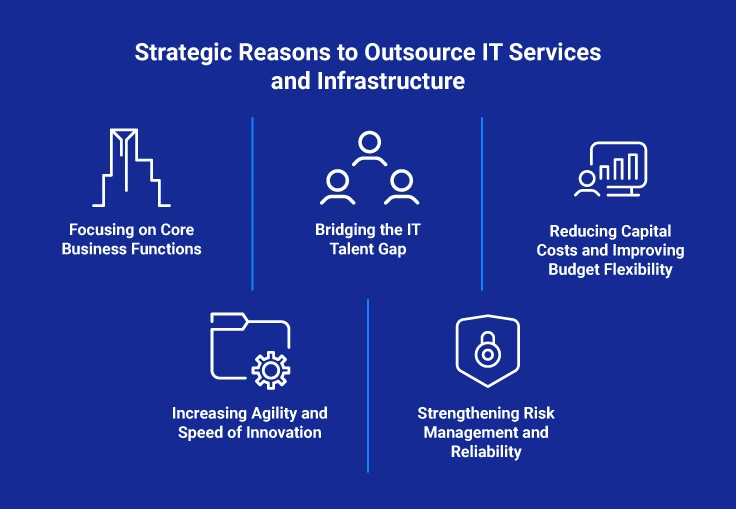
1. Focusing on Core Business Functions
As manufacturing IT environments become more complex, internal teams are often overwhelmed with system maintenance and day-to-day support. This diverts attention from core operations and slows down projects. Outsourcing helps shift this operational burden to a dedicated partner, allowing in-house teams to focus on driving business goals.
2. Bridging the IT Talent Gap
Keeping up with the evolution of technologies like cloud computing, AI, and IoT requires deep technical knowledge that’s increasingly difficult to find and retain. Given the global talent shortage and high hiring costs, building an in-house team with all required competencies is rarely feasible. Outsourcing provides manufacturers access to cross-functional IT teams with up-to-date certifications and domain-specific experience.

3. Reducing Capital Costs and Improving Budget Flexibility
Operating in-house data centers or IT teams comes with high fixed costs. Whether production is running at full capacity or on standby, the cost of servers, licenses, and internal support stays the same. Outsourcing replaces these fixed costs with a flexible, consumption-based model that aligns more closely with actual business activity.
4. Increasing Agility and Speed of Innovation
Launching new technologies or updating legacy systems can be delayed by bandwidth constraints within internal IT departments. With limited resources, projects like cloud migration, ERP upgrades, or factory connectivity rollouts often get deprioritized or postponed, holding back operational progress. Outsourcing brings in dedicated resources to execute these initiatives more efficiently, without overloading existing staff.
5. Strengthening Risk Management and Reliability
Manufacturers are under mounting pressure to maintain uptime, prevent cyber incidents, and meet strict regulatory standards like NIS2. For many companies, managing these requirements internally has become a resource-intensive challenge. Outsourcing gives manufacturers access to compliant IT environments, tools, and teams that specialize in meeting these standards.
Benefits of Outsourcing IT Services for Manufacturers

1. Cost Savings
One of the most immediate and visible benefits of outsourcing for manufacturers is cost reduction. Instead of owning servers, licenses, and full-time technical staff, you switch to a service-based model with predictable monthly expenses that align with your actual needs. You only pay for what you use, which is particularly valuable during plant downtimes, seasonal changes, or transitional periods.
2. Scalability and Workflow Flexibility
Manufacturing isn’t static, and your IT support shouldn’t be either. Outsourcing lets you scale IT resources up or down as needed, without delay or lengthy recruitment processes. Launching a new production line? Your service provider can add specialists overnight. Entering a slower season? Reduce headcount or service levels just as easily.
This flexibility applies to both infrastructure and personnel. Many outsourcing providers offer flexible full-time equivalent (FTE) models, supplying you with a mix of remote and on-site support to match plant-specific needs. Rather than committing to permanent headcount, you can request a specific number of IT specialists for a defined scope, location, and duration. These allocations can be adjusted monthly or quarterly to align with production schedules, eliminating the risk of overstaffing or resource gaps.
3. Improved Business Continuity and Security
Downtime isn’t just inconvenient, but also expensive. When systems fail, production stalls, orders are delayed, and revenue takes a hit. Outsourcing providers ensure your operations remain uninterrupted. They deliver 24/7 monitoring, rapid incident response, and proactive maintenance, all backed by service-level agreements (SLAs). Issues are identified and resolved before they affect operations.
Many outsourcing companies also offer built-in redundancy, disaster recovery, and geographically distributed support. With a combination of remote teams and on-site engineers, they can ensure consistent coverage across multiple locations and time zones. As a result, you get fewer disruptions, faster recovery, and IT systems that keep pace with your production needs.
4. Enhanced Performance and Operational Efficiency
With proven processes, automation tools, and deep technical expertise, providers help ensure your infrastructure, applications, and networks run smoothly. They fine-tune system configurations, proactively resolve issues, and monitor performance in real time. That means fewer bottlenecks, faster load times, and more stable environments, especially for critical systems like ERP, MES, and production control platforms.
By offloading routine IT tasks such as patching, backups, and user support, your internal team gains time to focus on high-impact initiatives. That might include improving factory data flows, integrating OT systems, or supporting innovation projects across the business.
5. Access to Advanced Technology and Expertise
Keeping up with modern IT is a full-time job, and for many manufacturers, not a feasible one to do alone. Outsourcing gives you direct access to technologies and skills that would take years to build internally.
Third-party providers bring in-depth experience with cloud platforms, cybersecurity, industrial IoT, data analytics, and automation tools. They stay current with best practices and regulatory standards, and bring that knowledge into your business from day one, saving you time on training the internal team or recruiting new staff. This helps you adopt new technologies quickly and keep your operations running with the latest tools, giving you a real competitive advantage.
Emerging Trends in Manufacturing Driving IT Outsourcing Decisions
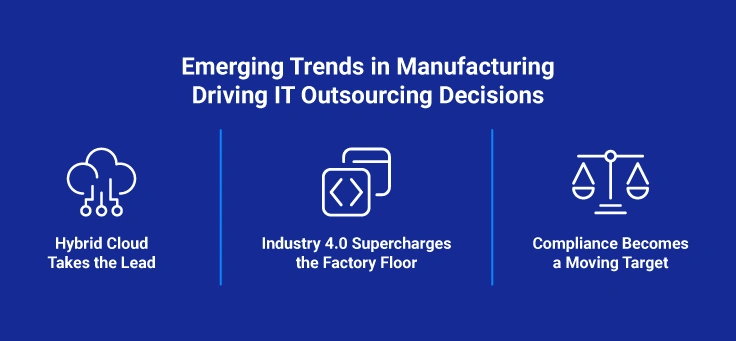
Adaptability and flexibility are the key to staying competitive. That’s why more manufacturers are turning to IT outsourcing, not just to ease the burden on internal teams, but to respond quickly and effectively to changes. The following trends are shaping how manufacturers approach IT today and explain why many are choosing to work with external partners.
- The Rise of Hybrid Cloud Infrastructure: Manufacturers increasingly adopt hybrid cloud strategies that combine on-premises systems with public or private cloud services. This model allows sensitive production systems to remain in-house for reliability, while cloud platforms handle analytics, planning, and multi-site coordination. Outsourcing providers help design, implement, and manage these environments to ensure they perform reliably and securely.
- Industry 4.0 and IoT: Smart factories depend on connected sensors, real-time data, and machine learning—all of which demand scalable, secure, and high-performance IT infrastructure. By partnering with an external company, you get the tools and expertise needed to support IoT integration, data processing, and analytics without overloading internal resources.
- The Increased Complexity of Compliance: Whether it’s GDPR, ISO 27001, NIS2, or industry-specific standards, compliance is becoming more demanding and resource-intensive. Many manufacturers turn to outsourcing to access environments and teams already aligned with these frameworks, reducing risk and internal compliance overhead.
Real-World Case Studies: How Manufacturers Benefit from IT Outsourcing
Many manufacturers have already made the shift to outsourced IT, not just to reduce costs, but to modernize infrastructure and accelerate digital transformation. Below are two real-world examples that illustrate how IT outsourcing supports operational goals in complex manufacturing environments.
Thyssenkrupp: From Fragmented Systems to a Unified IT Environment
Thyssenkrupp was struggling with outdated systems, inconsistent IT standards, and limited collaboration tools across its global sites. By outsourcing IT infrastructure upgrades, the company consolidated networks, replaced aging hardware, and migrated over 2,500 users to a centralized domain, creating a unified IT environment that improved productivity, simplified support, and laid the foundation for future growth.
Ebro Armaturen: Migrating to Managed Services and PaaS
As Ebro Armaturen operations expanded, so did the need for a scalable, stable IT setup. By moving to a managed services model, the company ensured reliable performance for its ERP, archiving, quality management, and sales platforms. When it was time to scale further, Ebro seamlessly migrated to a new Comarch Data Center in Dresden, bringing more users, applications, and services under a single unified infrastructure with over 99.8% availability.
Key Takeaways
- 42% of industrial manufacturers already rely on IT outsourcing for automation control systems, simulation software, and analytics tools.
- Manufacturers are outsourcing IT to modernize aging systems, manage rising complexity, and free up internal teams to focus on production and innovation.
- IT outsourcing helps bridge the growing IT talent gap, giving manufacturers access to specialized expertise without hiring or training in-house.
- Trends like hybrid cloud, IoT, and stricter compliance are accelerating the need for external IT support
Transform Your IT Operations with Comarch
IT outsourcing has evolved from a support tactic to a strategic move to address growing complexity, accelerate digital transformation, and ensure business continuity. Faced with rising costs, talent shortages, and the need for scalable, secure infrastructure, more manufacturing companies are turning to external partners to modernize and stabilize their IT environments.
With the right partner, IT outsourcing can become a real competitive advantage. At Comarch, we offer comprehensive IT services tailored to the needs of manufacturers, from infrastructure and cloud management to 24/7 support and compliance.
Want to explore what this could look like for your organization? Schedule a free consultation with our experts, and let’s discuss how we can help streamline your IT operations.