How to Choose an IT Outsourcing Partner: What to Look for and What to Avoid

IT outsourcing is on the rise, with the market projected to grow from $541.1 billion in 2024 to $812.7 billion by 2029. For many enterprises, it’s no longer a question of whether to outsource, but how to do it right. Choosing an IT outsourcing partner is a strategic decision with long-term consequences. The wrong choice risks cost overruns and compliance issues, while the right one accelerates efficiency, scalability, and innovation.
Keep reading to discover:
- Key criteria for evaluating outsourcing partners
- Practical steps to reduce risk during vendor selection
- Common mistakes in choosing an IT outsourcing provider
Why Selecting the Right Outsourcing Partner Matters
Outsourcing evolved from merely a way to cut costs to a source of a competitive advantage. Enterprises rely on outsourced teams to handle complex IT functions, integrate new technologies, and secure global operations. The right outsourcing partner enables companies to gain:
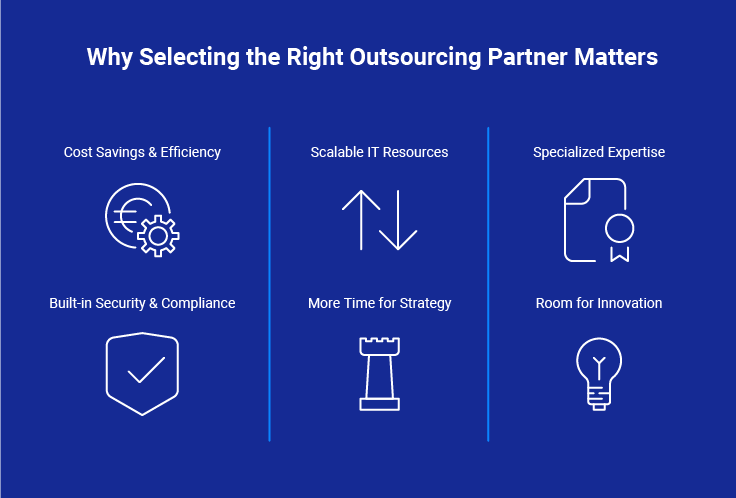
- Cost savings and greater efficiency through streamlined operations, predictable pricing, and access to high-quality services at a lower price compared to building an internal IT team.
- Flexibility to scale IT resources up or down as your needs change.
- Specialized expertise you don’t have to build in-house, from cloud migration to cybersecurity.
- Built-in compliance and security supported by proven processes and certifications.
- More time for strategy as internal teams can focus on growth instead of routine support.
- Room to innovate with access to new tools and technologies as they emerge.
When collaboration is successful, an outsourcing provider becomes a crucial part of your team, supporting your long-term goals and delivering measurable results. However, if you choose wrong, the opposite happens - costs spiral, projects stall, and your in-house teams end up spending even more time fixing problems than they did before. So, how to choose an ideal outsourcing partner? That’s what we’ll examine next.
Key Evaluation Criteria for Outsourcing Partners
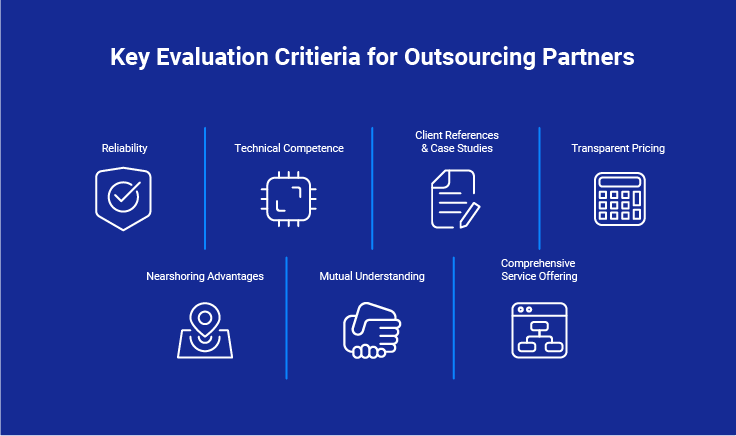
Reliability
A reliable partner has a proven track record with long-term clients and the financial stability to support global projects. Look for evidence of continuity, such as partnerships that have lasted years, not months. Stability reduces risk during transitions and ensures smoother operations over time.
Technical Competence
Complex IT projects demand specialized expertise. A strong partner should demonstrate high-level capabilities in all areas you want to outsource, such as cloud migration and management, system integration, IT infrastructure administration, end-user comprehensive support, and cybersecurity. Industry certifications such as ISO 27001 or ITIL indicate maturity and commitment to best practices, while 24/7 support ensures stability in global operations.
Client References and Case Studies
An IT outsourcing company may look good on paper, but actions speak louder than words. Look for references and case studies to evaluate the vendor’s real-world performance. They show how a provider handles complex challenges, meets compliance standards, and adapts to industry-specific requirements. Peer feedback and documented success stories give executives confidence that the vendor can deliver what it promises.
Transparent Pricing
Outsourcing should bring predictability, not surprise invoices. Clear pricing models—whether fixed-price, per-unit, or time-and-material—allow executives to align budgets with business objectives. Transparency is the foundation of trust, as both sides understand what drives costs and how value is measured.
Nearshoring Advantages
Offshoring may seem cost-effective, but it’s also riskier. A long-distance partnership may lead to delays, hidden costs, and weaker oversight. Meanwhile, nearshoring strikes a balance between cost savings and close collaboration. By working with outsourcing providers in nearby regions, enterprises benefit from overlapping time zones, regional familiarity, and easier communication.
Mutual Understanding
Technology alone doesn’t guarantee success. An outsourcing partnership must also work on an interpersonal level. Shared values, compatible communication styles, and similar approaches to problem-solving help reduce friction and build trust. Choosing a partner who demonstrates a genuine interest in your brand and objectives ensures they are committed to aligning with your needs and safeguarding your best interests. Without this alignment, even technically strong projects can run into delays and misunderstandings.
Comprehensive Service Offering
Managing multiple vendors adds complexity, creates gaps between services, and often drives costs higher. A partner with a broad portfolio—from consulting and integration to cloud operations and end-user support—simplifies governance and ensures consistent quality. A single provider covering the full scope of IT needs also makes it easier to scale and adapt as business priorities change.
6 Steps to Select the Right Outsourcing Partner
Once the evaluation criteria are clear, the next step is applying them in a structured selection process. A disciplined approach reduces risk and ensures the chosen partner aligns with both strategic goals and day-to-day operations.
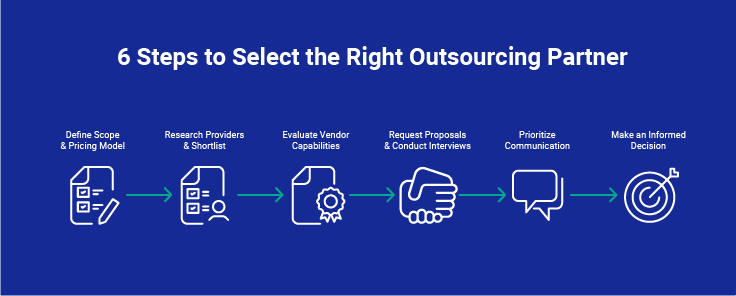
Step 1. Identify the Scope of Outsourcing and Optimal Pricing Model
Before researching outsourcing providers, make sure you know exactly what you’re looking for. Outline your IT outsourcing needs—define processes and services you want to outsource, set measurable goals, and choose an outsourcing model, as well as a pricing model that best fits your objectives. Establishing clear expectations early on ensures you focus only on providers that align with your business requirements.
Step 2. Research Potential Providers and Build a Shortlist
Start by mapping the market and creating a shortlist of potential outsourcing partners. Look for providers with proven experience in your industry, a suitable service portfolio, and the ability to support your scale and geography. Consider their global presence and delivery models—whether nearshore, offshore, or hybrid—to match your operational needs. Last but not least, gather references to understand how they deliver in practice.
Step 3. Evaluate Vendor Capabilities
Once you have a shortlist, assess each vendor’s qualifications in detail:
- Verify industry certifications, such as ISO 27001 or ITIL.
- Assess security measures and compliance with data protection standards.
- Review the technology stack to ensure alignment with your existing infrastructure.
- Pay attention to the flexibility and availability of 24/7 support to ensure the potential vendor can adapt to changing business needs.
- Look for case studies and references that demonstrate proven experience in your industry.
- Evaluate the provider’s team size and skills to confirm they can meet your specific project requirements.
Step 4. Request Proposals and Conduct Interviews
Gain a deeper understanding of the top vendor’s offerings and approaches by requesting detailed proposals that outline their solutions, pricing, and timelines. This stage is often preceded by a Request for Information (RFI), which helps you gather high-level data from a wide pool of vendors and narrow it down to the most relevant candidates. The RFP (Request for Proposal) phase then allows you to evaluate in detail how each vendor’s offer matches your needs. Use in-depth interviews to clarify details and assess how well a potential provider aligns with your company culture.
Step 5. Prioritize Communication
Strong communication practices are the foundation of a successful partnership. Evaluate how vendors handle reporting, response times, and project management. Ensure the provider can accept calls, tickets, or urgent requests from your team, regardless of time zone. Transparent communication builds trust and reduces the risk of misalignment. If a potential partner is slow to respond during early discussions, it may indicate future challenges in collaboration.
Step 6. Make an Informed Decision
Bring together all findings—pricing, service quality, reputation, and shared values. Select the partner that not only meets technical requirements but also shows commitment to long-term collaboration and strategic alignment.
Common Mistakes to Avoid in Selecting an IT Outsourcing Partner
Even with a structured process, many IT outsourcing initiatives fall short because of avoidable errors. Being aware of the most common mistakes helps executives reduce risk and make better decisions.
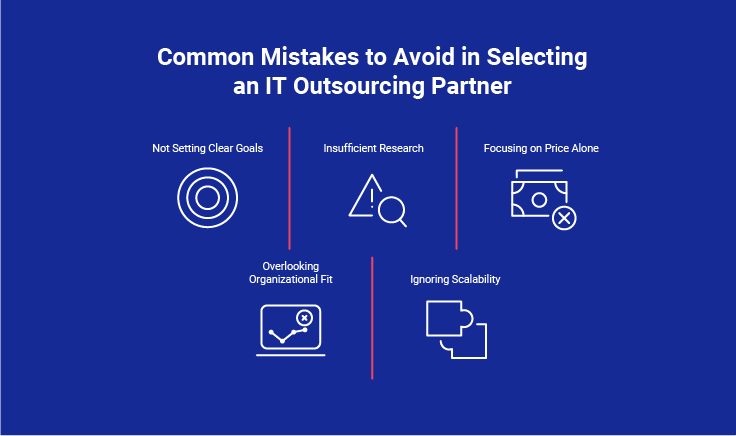
- Not Setting Clear Goals: Unclear objectives lead to miscommunication, poor results, and wasted resources.
- Insufficient Research: Skipping research, or worse, not doing it at all, can lead to choosing unqualified partners and costly mismatches with your business needs.
- Focusing on Price Alone: The cheapest offer often hides hidden costs, lower service quality, or limited flexibility.
- Overlooking Organizational Fit: Misaligned communication styles or work practices can slow down projects and create friction.
- Ignoring Scalability: A partner that meets today’s needs but can’t adapt to future growth will hold the business back.
Avoiding these pitfalls ensures that outsourcing supports long-term business goals rather than creating new challenges.
Choose the Best Outsourcing Partner for Your Business Strategy
Selecting the ideal outsourcing partner is one of the most important IT decisions global enterprises face. The choice shapes efficiency, scalability, and innovation for years to come. By setting clear goals, evaluating key criteria, and conducting thorough research, businesses can minimize risk and ensure long-term success.
With decades of experience in complex IT environments worldwide, Comarch delivers outsourcing solutions that combine reliability, technical excellence, and mutual understanding. Our end-to-end services cover consulting, integration, and long-term support, making us a trusted choice for organizations that want to simplify IT while driving growth. We support enterprises across diverse industries, including leaders such as Thyssenkrupp or the European Southern Observatory.
Ready to take the next step? Contact our experts to discuss your outsourcing strategy and discover how we can help your enterprise scale with confidence.
To explore the topic further, you can read our dedicated e-book: The Ultimate Guide to Successful IT Outsourcing Implementation