8 Proven IT Cost Reduction Strategies That Shift Spending from Capex to Opex
IT budgets are on the rise. While companies anticipate a 4.6% increase in 2025, Gartner’s forecast of a 9.8% global spending surge poses a critical question for technology leaders: will that extra money fund innovation or simply feed an inefficient machine?
Without a clear plan for IT cost reduction, rising operational costs for legacy systems can consume your entire budget, leaving no room for the strategic projects that drive business growth. To avoid this maintenance trap, leaders must adopt a more flexible and efficient spending model.
Keep on reading to discover how you can:
- Convert Capex to Opex
- Maximize the value of specialized skills without the expense of a full-time staff
- Pinpoint and eliminate hidden waste in your software subscriptions
- Refocus your internal IT team from daily maintenance to strategic projects
1. Embrace the Cloud: The Ultimate Capex to Opex Play
For years, the traditional IT model was defined by massive upfront investments. Today, the single most effective cost reduction strategy involves a fundamental financial shift away from this old approach.
Adopting cloud computing transforms your IT budget from a series of large, unpredictable Capital Expenditures (Capex) into a smooth, manageable stream of Operational Expenditures (Opex). This move provides financial agility and predictability, which are crucial for any modern business looking to reduce costs in IT.
Eliminate Hardware Investment with IaaS & PaaS
The most significant source of IT Capex has always been physical hardware. With IaaS and PaaS from providers like AWS, Microsoft Azure, or specialized enterprise partners like Comarch, you effectively rent computing power instead of owning it. This completely eliminates the need to purchase, house, and maintain your own physical servers, storage arrays, and networking equipment.
Think of the costs this removes:
- The initial multi-thousand-dollar server purchase
- The expense of data center space
- The high electricity bills for power and cooling
- The staff hours spent on hardware maintenance
All of that is converted into a single, predictable monthly Opex bill. You pay only for the resources you consume and can scale up or down instantly, ensuring you never pay for idle capacity.
Streamline Operations with SaaS
This Opex model extends to your software. Instead of buying expensive, perpetual software licenses for CRM or ERP systems, SaaS offers a better way. Enterprise platforms like Comarch ERP, Salesforce, and Microsoft 365 operate on a predictable per-user, per-month subscription fee.
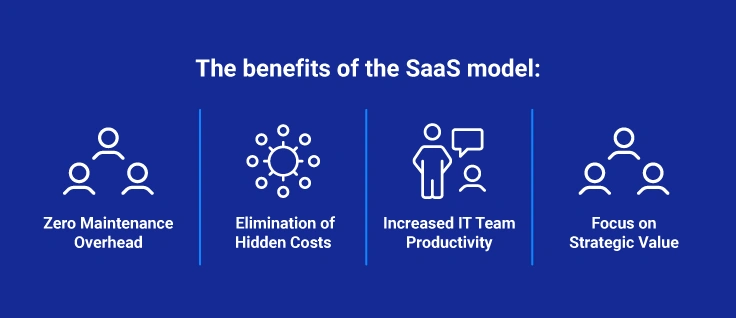
And the benefits of the SaaS model go far beyond the initial cost savings, directly impacting your team's efficiency and focus:
- Zero Maintenance Overhead: The SaaS provider handles all maintenance, security patches, and version updates, which are included in your subscription.
- Elimination of Hidden Costs: You avoid unexpected expenses related to software upgrades, bug fixes, or compatibility issues.
- Increased IT Team Productivity: Your internal IT staff is freed from tedious, routine patch management and support tasks.
- Focus on Strategic Value: This allows your team to shift its focus from "keeping the lights on" to strategic initiatives that drive business growth and innovation.
2. Leverage Managed IT Services for Specialized Skills
One of the most significant and often hidden drains on an IT budget is underutilized talent. As technology becomes more complex, the need for specialists in areas like cybersecurity, database management, or cloud architecture grows.
However, for many businesses, the workload doesn't justify a full-time hire. This creates an expensive inefficiency that is a prime target for a smart IT cost reduction strategy.
As reported by Fortra, 65% of respondents listed IBM i skills as a top concern in 2024.
Maximize Expert Utilization
Consider a common scenario: a mid-sized company hires a dedicated cybersecurity expert. Their skills are absolutely critical for protecting the business, but high-stakes security tasks may only demand their full attention 50% of the time. The other 50% is spent on lower-value tasks or simply being on standby. Yet, the company pays for 100% of their salary, benefits, and the continuous training required to keep their skills sharp.
The solution in both these cases is to partner with a managed IT services provider. Instead of hiring one person, you gain access to an entire team of specialists on a flexible, subscription basis. This allows you to tap into high-level expertise precisely when you need it, without the financial burden of a full-time salary.
According to research from IDC, almost 70% of companies use third-party managed services providers to manage their IT operations, and a further 20% plan to adopt them in the next 18 months.
By leveraging a managed service provider like Comarch, you convert an inefficient and unpredictable personnel expense into a fixed, predictable monthly Opex fee. The provider’s experts are fully utilized across their entire client base, ensuring you get maximum value for your investment and a powerful method for reducing IT costs.
3. Outsource Non-Core IT Functions
Beyond leveraging specialized skills, one of the most powerful IT cost reduction tactics is to strategically outsource entire non-core functions. Every business has IT operations that are absolutely vital for daily work but are not part of its primary value proposition. By entrusting these tasks to a dedicated third party, you can unlock significant savings and empower your internal team to focus on what truly matters: growing the business.
Focus on What You Do Best
Take a critical look at where your IT team spends its time. How many hours are dedicated to functions like running the IT helpdesk, performing 24/7 network monitoring, or managing complex data backup and disaster recovery plans? While essential, these are operational burdens that can be handled more efficiently and cost-effectively by a specialized provider.
An external partner achieves economies of scale that an in-house team simply cannot. They have invested in the most advanced tools, a deep bench of expert staff, and highly refined business processes, spreading the cost of this top-tier infrastructure across their entire client base. They can perform these functions better, faster, and often cheaper than you can yourself.
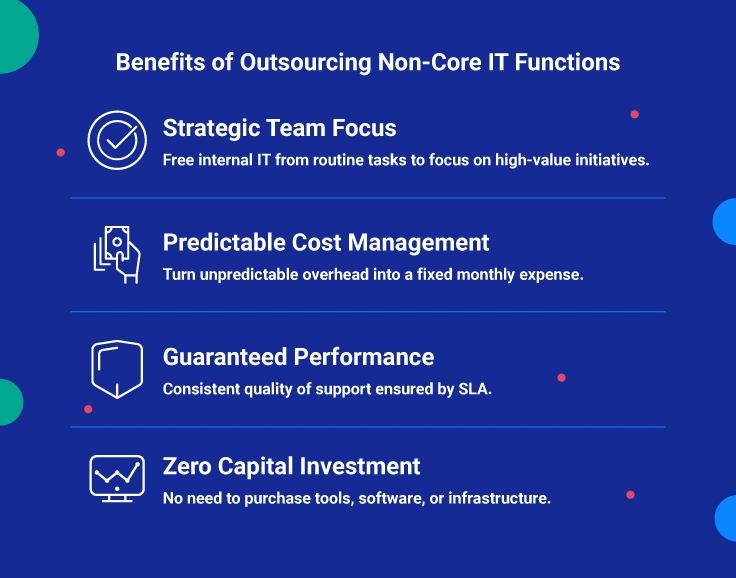
Outsourcing non-core IT functions (such as 24/7 monitoring or user support handled by Comarch’s Global Operations Center) provides several key advantages for your business:
- Strategic Team Focus: It liberates your internal IT talent from reactive, "keep the lights on" tasks, empowering them to concentrate on high-value strategic initiatives that drive innovation and revenue.
- Predictable Cost Management: This strategy converts unpredictable operational overhead into a fixed, reliable monthly expense, eliminating budget surprises and improving financial planning.
- Guaranteed Performance: Service levels are contractually guaranteed through an SLA, ensuring you receive a consistent and high-quality level of support.
- Zero Capital Investment: You completely avoid the need for large capital expenditures on the specialized tools, software, and infrastructure required to manage these functions in-house.
4. Conduct a Thorough IT and Software Licensing Audit
Some of the most significant opportunities for IT cost reduction aren't found in new technologies, but hidden within your existing monthly expenses. Over time, as companies grow and evolve, their software portfolio can become a maze of redundant, forgotten, and underutilized subscriptions. Unseen waste is a major source of inflated IT budgets, and a thorough audit is the flashlight that reveals where you can make immediate cuts without impacting performance.
Uncover "Shelfware" and Redundant Services
In the world of IT, "shelfware" refers to software licenses that your company pays for but that go completely unused. This often happens silently; an employee leaves the company, a project's focus shifts, or a free trial automatically converts to a paid plan that no one uses.
According to SaaS management platform ZYLO, a staggering 53% of SaaS licenses go unused or underused on average. That means you could be paying for two licenses for every one that provides actual value.
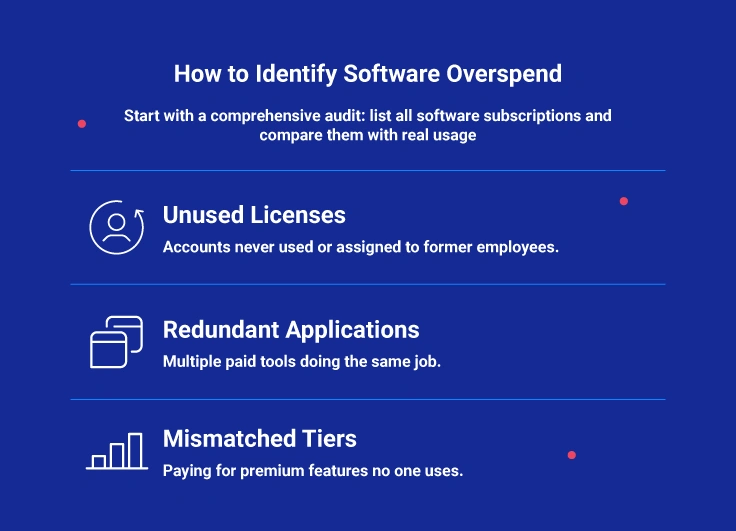
The actionable step is to conduct a comprehensive audit. Create a master list of every software subscription and license your company pays for. Then, cross-reference this list with actual user login and usage data to identify:
- Unused Licenses: Accounts assigned to former employees or that haven't been accessed in over 90 days.
- Redundant Applications: Departments using different paid tools that perform the same function (e.g., paying for Asana, Trello, and Monday.com simultaneously).
- Mismatched Tiers: Paying for premium-tier features that your team doesn't actually use.
By consolidating vendors, eliminating unused licenses, and right-sizing your subscription tiers, you can reduce IT costs every single month. It's one of the quickest ways of cost cutting with zero negative impact on productivity.
5. Automate Repetitive IT Processes
Your IT team's time and expertise are among your company's most valuable assets. A critical strategy for reducing IT costs is maximizing the value you get from your existing team. Every hour a skilled technician spends on a manual, repeatable task is an hour not spent on innovation. Automation is the key to unlocking this trapped potential and boosting operational efficiency.
From Manual Tasks to Automated Workflows
Modern automation tools, including Generative AI and Robotic Process Automation, are designed to handle the routine, rules-based tasks that consume a significant portion of an IT department's day. Consider the time spent on processes like:
- User Provisioning: AI-driven identity management automates account setup based on roles and instantly revokes access upon departure, removing manual delays and security risks.
- System Patching: Instead of manual updates, AI-enhanced tools prioritize vulnerabilities by risk level and autonomously deploy patches during optimal windows.
- Report Generation: Generative AI replaces manual data compilation, allowing staff to instantly generate complex visualizations and summaries using simple natural language queries.
- Tier 1 Support: AI-powered chatbots resolve routine tickets (like password resets) instantly, freeing up expensive engineering hours for complex issues.
- Predictive Maintenance: AIOps analyzes log data to predict hardware failures or crashes before they happen, preventing costly downtime and emergency repairs.
These tasks can be executed flawlessly in a fraction of the time. The impact is profound. You reclaim countless staff hours for higher-value strategic projects and significantly reduce the risk of human error that can lead to security vulnerabilities or system downtime. Automation ensures essential tasks are completed consistently and on schedule, 24/7.
While some automation platforms require an initial investment, many are available as Opex-friendly subscription services. The long-term return on investment is undeniable. By reducing manual labor costs, minimizing errors, and increasing the overall efficiency of your IT operations.
6. Optimize Your Data Storage Strategy
In 2024, the global volume of data reached 149 zettabytes. But as that data grows exponentially, so do the costs to store and manage it. Simply throwing more money at storage is not a sustainable solution. A more sophisticated approach to IT cost reduction involves treating your data intelligently, ensuring you're not paying a premium to store information that you rarely, if ever, access.
Implement Tiered Storage
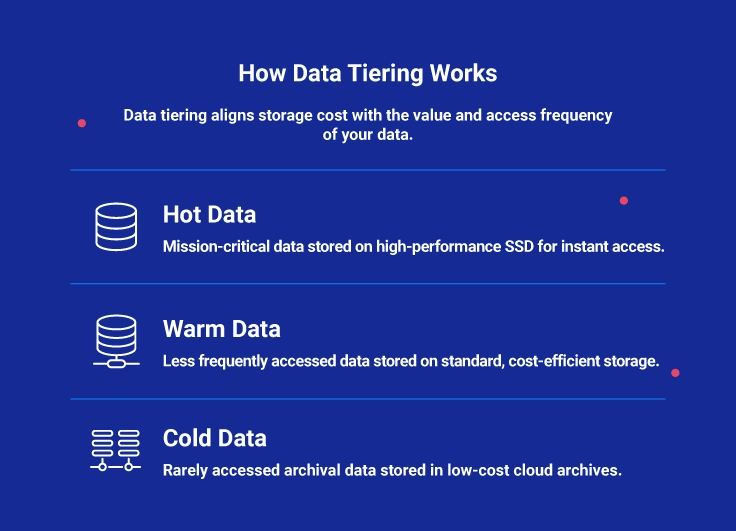
The core concept of data tiering is simple: not all data is created equal. A tiered storage strategy aligns the cost of storage with the value and access frequency of the data itself.
This approach automatically migrates data between different storage levels based on predefined policies:
- Hot Data: This is your mission-critical, frequently accessed data that powers your daily operations. It resides on the highest-performance storage (like SSDs) for instant access.
- Warm Data: This includes less frequently accessed data, like recent project files or quarterly reports. It can be moved to more cost-effective standard storage without a noticeable impact on users.
- Cold Data: This is archival data that must be retained for compliance or historical records but is rarely needed. This data is moved to extremely low-cost cloud archival solutions, such as Amazon S3 Glacier or Azure Archive Storage, for just fractions of a penny per gigabyte.
By ensuring you only pay premium prices for the small percentage of data that requires instant access, you can drastically lower your overall storage bill, whether your infrastructure is on-premise or in the cloud.
7. Consolidate Vendors and Renegotiate Contracts
IT landscapes often grow organically, leaving a trail of disparate contracts and missed opportunities for savings. Proactive management of your vendor relationships is a key discipline for effective IT cost reduction, ensuring you're consistently getting the most value for your money.
Leverage Your Buying Power
It's a valuable exercise to periodically review every IT vendor contract you have, from your internet service provider and cloud hosting to your various SaaS subscriptions. You may discover that different departments have signed separate agreements with the same provider, completely missing out on the volume discounts you're entitled to. This "contract sprawl" is a common source of budget leakage.
The actionable step is twofold. First, identify where you can consolidate services with a smaller number of strategic partners to increase your buying power. Second, mark your calendar for 90 days before any contract is set to auto-renew. Use this time to shop around and get competitive quotes. Armed with this market data, approach your current vendor to renegotiate for better terms. Most vendors are willing to offer a discount to retain a reliable, long-term client, especially when faced with a competitive offer.
8. Invest in Employee Training on Security and Efficiency
While technology solutions often dominate discussions around IT cost reduction, one of the most critical—and often overlooked—factors is the human element. Untrained or unaware employees can inadvertently become a significant source of inflated IT costs, ranging from minor inefficiencies to catastrophic security breaches. Proactive investment in user education is a powerful, preventative strategy that yields substantial long-term savings.
A Well-Trained User is a Cost-Saving Asset
Untrained users drive up costs in several ways. They might use software inefficiently, leading to wasted time and missed productivity. More critically, they can fall victim to sophisticated cyberattacks like phishing, directly exposing your organization to massive financial and reputational damage.
The IBM Cost of a Data Breach 2024 report reveals the average global cost of a breach has risen to an alarming $4.88 million. This figure represents regulatory fines, legal fees, customer churn, and brand damage on top of the financial loss.
Furthermore, reports show a dramatic increase in threats. Phishing attacks have surged by an astonishing 4,151% since ChatGPT's public launch in late 2022, according to SlashNext, making user vigilance more critical than ever.
Invest in ongoing training for your employees. This should cover:
- Cybersecurity Best Practices: How to spot phishing attempts, create strong passwords, identify suspicious links, and understand the company's security policies.
- Efficient Software Utilization: Ensuring employees fully leverage the features of core applications, reducing redundant work and improving productivity.
Proactive investment, which typically falls under a manageable Opex, prevents massive, reactive costs down the line. Fewer helpdesk tickets mean less strain on your IT support staff, while a lower risk of security incidents protects your organization from multi-million dollar breaches. Ultimately, a well-informed and efficient workforce is one of the most effective forms of IT cost reduction.
Your IT Choice: Cost Center or a Predictable Asset?
Reducing your IT cost is ultimately about gaining financial control. It requires moving from large, unpredictable capital expenditures to a model of steady, manageable operational costs.
With smart strategies, your IT budget stops being a source of financial surprises and becomes a predictable component of your monthly planning. By focusing on these tricks, you are building a more resilient and financially sound operational foundation for your entire business.
And they are already delivering real-world results. We've seen how organizations like Boost E-Wallet solve critical business issues with data center services, how Ebro Armaturen benefits from managed PaaS solutions, and how companies like Schnellecke optimize their entire ICT infrastructure. They are proving that the move to a modern, managed model drives performance and security.
Are you ready to see a real-world breakdown of these costs for your own business? To fully understand the financial impact of moving away from physical hardware, download our free eBook: The True Cost of On-Premise Data Centers. It provides a detailed analysis that will help you build a powerful business case for change.