Comarch IoT MES
What is Comarch Manufacturing Execution System (MES)?
Comarch Manufacturing Execution System (MES) is a production management system, that is software used to support and track manufacturing processes. It collects key production data in real time, straight from machines and workstations. Next, it analyzes the data and displays the information in a user-friendly way.
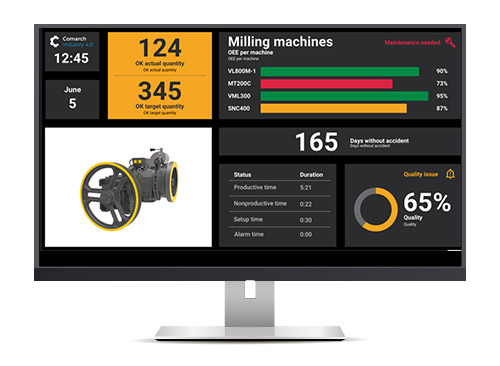
All the information, including OEE indicators and other KPIs, can be presented on operator screens and an Andon board used by the entire team, as well as transferred to ERP systems and BI applications.
Thanks to MES systems, managers and executives can monitor production in real time and make operational and business decisions based on generated production efficiency reports, which translates to production optimization and an overall increase in productivity.

The essential features of MES, responding to the main needs of manufacturing companies, include:
- Elimination of paper documentation
- Data integration – connection between ERP and MES systems
- Tracking machine and employee work time
- Optimization of production processes
- Elimination of errors and processing of manually entered data
- Digitization of production processes
- Real-time access to production results
Streamlining the planning and data collection process - Improved efficiency and quality of production processes
- Generation of collective reports
- Tracking downtime and micro downtime
- Remote access and online order management

Optimize manufacturing management – Choose Comarch IoT MES
In Comarch IoT MES, we make use of several decades of Comarch’s experience in the field of software development, as well as over 10 years of experience in the areas of production planning and implementation using state-of-the-art Internet of Things technologies.
Our solution fits into the Industry 5.0 idea and is dedicated to industrial companies carrying out discrete, cell, and continuous manufacturing.

Why do clients choose Comarch IoT MES?
- Modern and easy-to-use software interface
- System flexibility – the system grows together with the production processes
- Ease of data integration and transfer between systems
- Ability to quickly identify and solve production problems, eliminating waste and fight bottlenecks
- Guarantee of improved quality and efficiency of production in a short time
- System modules are developed in accordance with the ISA-95 and ISO 22400 standards
UNS
Unified Namespace, that is a single source of information compliant with the ISA-95 standard, containing all data on the structure and current status of the entire enterprise. The system is created on the basis of modern distributed architecture to solve the problems associated with traditional industrial data architecture.
Rather than placing data in silos within and between layers of the technology stack, it is placed in a unified manner so that all enterprise systems have one centralized location from which they can get the data they need to accomplish their goals, while maintaining the highest possible access speeds to reach that data in a given infrastructure.

Andon boards
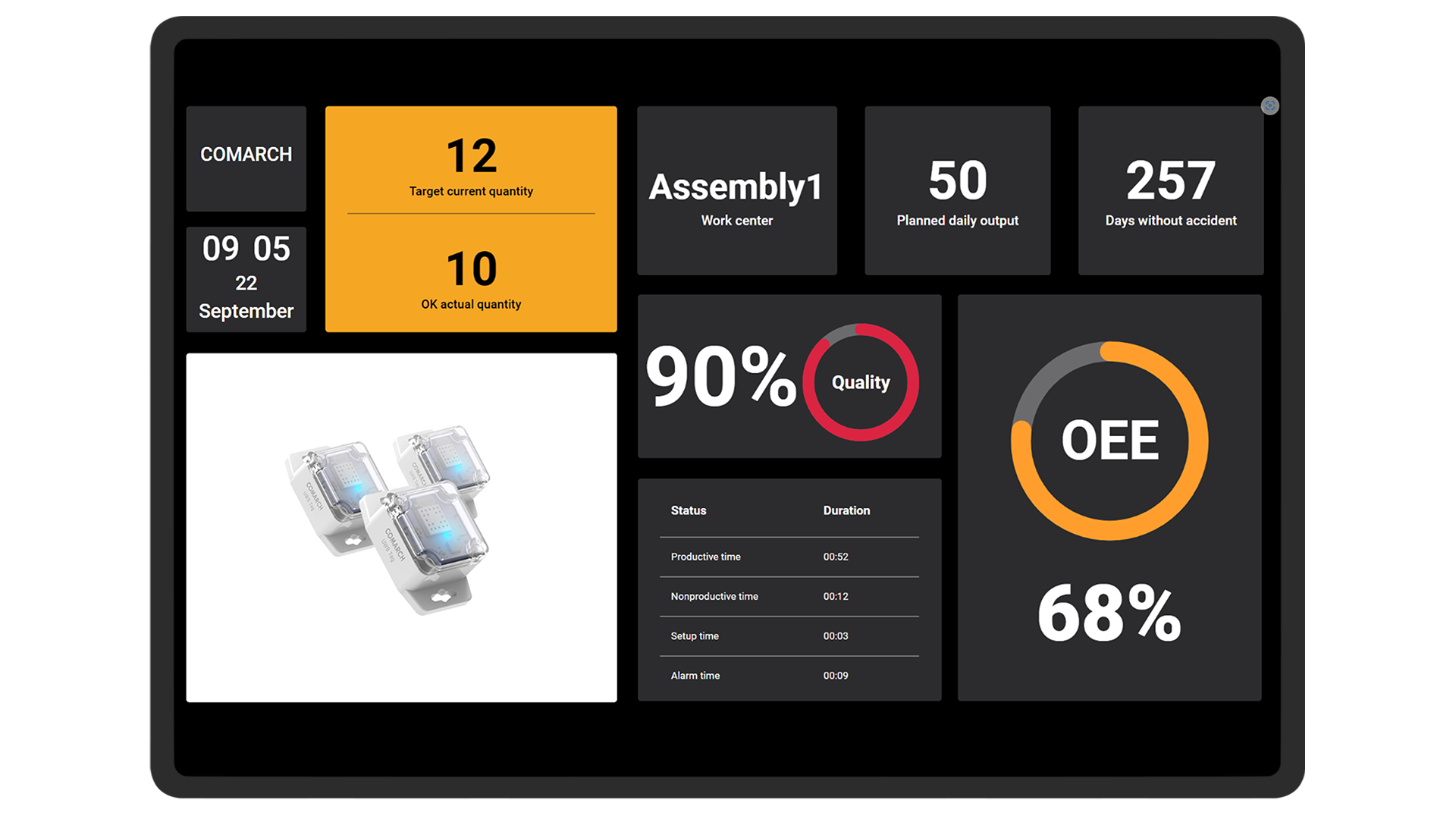
Key production data may be displayed on Andon boards in real time. The information is also saved in the database to allow conclusions to be drawn and the production process to be improved continuously.
Supervisor
Supervisor is a component of an information system that allows supervising the progress of a technological or production process for multiple machines/production lines simultaneously.
It enables you to easily monitor what exactly is happening on the entire production floor at any moment, providing insight into the status and execution of orders, downtime and production rates, failures, quality data, etc. It is also the management center for the entire system: its users, accesses, notifications, and settings.
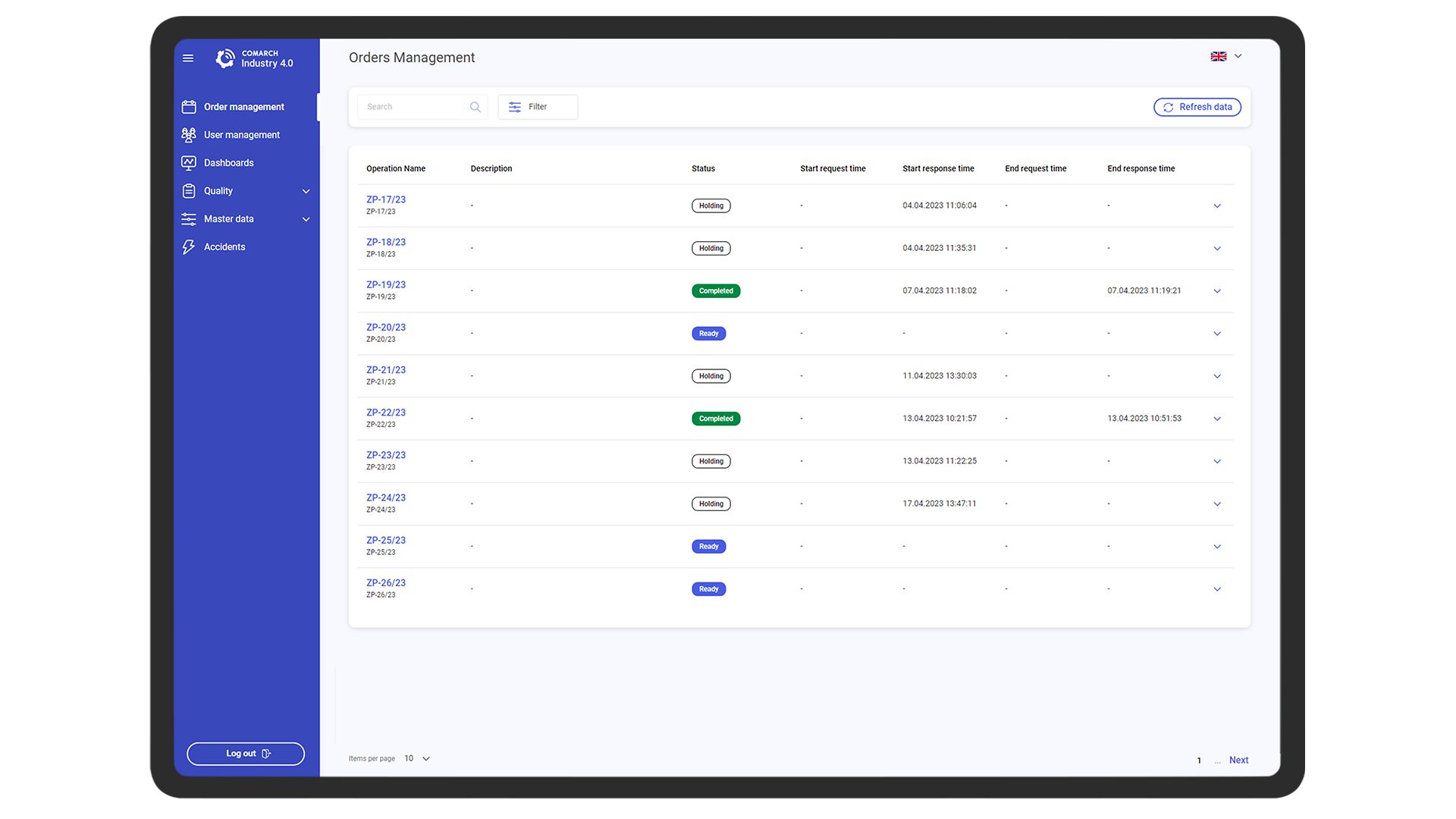
Comarch IoT MES application in the operator panel
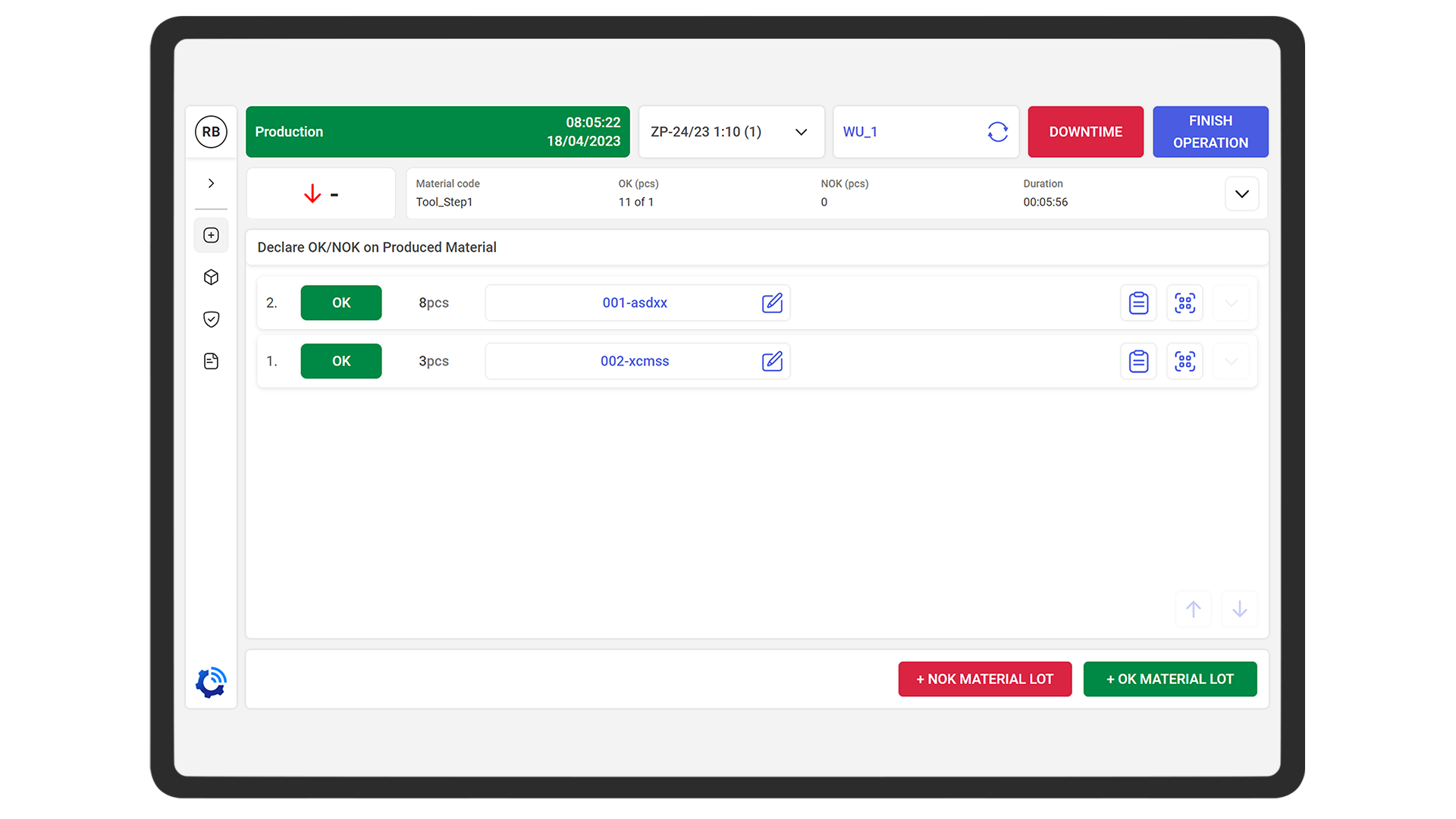
The application is a key element of Industry 5.0 solutions provided by Comarch. It is thanks to the application that it is possible to collect and process data gathered directly from production processes.
As a result, the obtained information allows production control (NOK and OK data) in real time. On the basis of this information, it is possible to determine the OEE value. Comarch IoT MES application is available in desktop and mobile version for tablets, in several language versions, including Polish, English, German, and Italian.
IoT
Thanks to IoT technology, Comarch MES may be connected to any machine/production line (including the older ones – thanks to the possibility of their modernization (retrofitting) using modern sensors or additional equipment).
Therefore, production data can be collected automatically and in real time. Such an approach eliminates human error and streamlines work. We support standard industrial protocols and machine connection methods, such as MQTT, OPC UA, IO signals and others.

Discover the key features of Comarch IoT MES application:
- Production panel for the operator
This a touchscreen supporting operators’ work. It displays necessary information on executed production orders and operators, including the current OEE indicator. It allows downtime to be declared, and reports about the current production status or quality control. Data may be entered using the touchscreen, a connected keyboard, or a code scanner.
- OEE measurement
The OEE indicator is one of the most important coefficients for measuring production efficiency. OEE is calculated as the product of three manufacturing components: availability, quality, and performance. Analysis of the OEE indicator allows the detection of bottlenecks, which limit the overall efficiency of machines/production lines. Also, it shows where losses occur in the production process.
Calculate OEE, define other indicators, and track them all, improving the efficiency of your production processes.
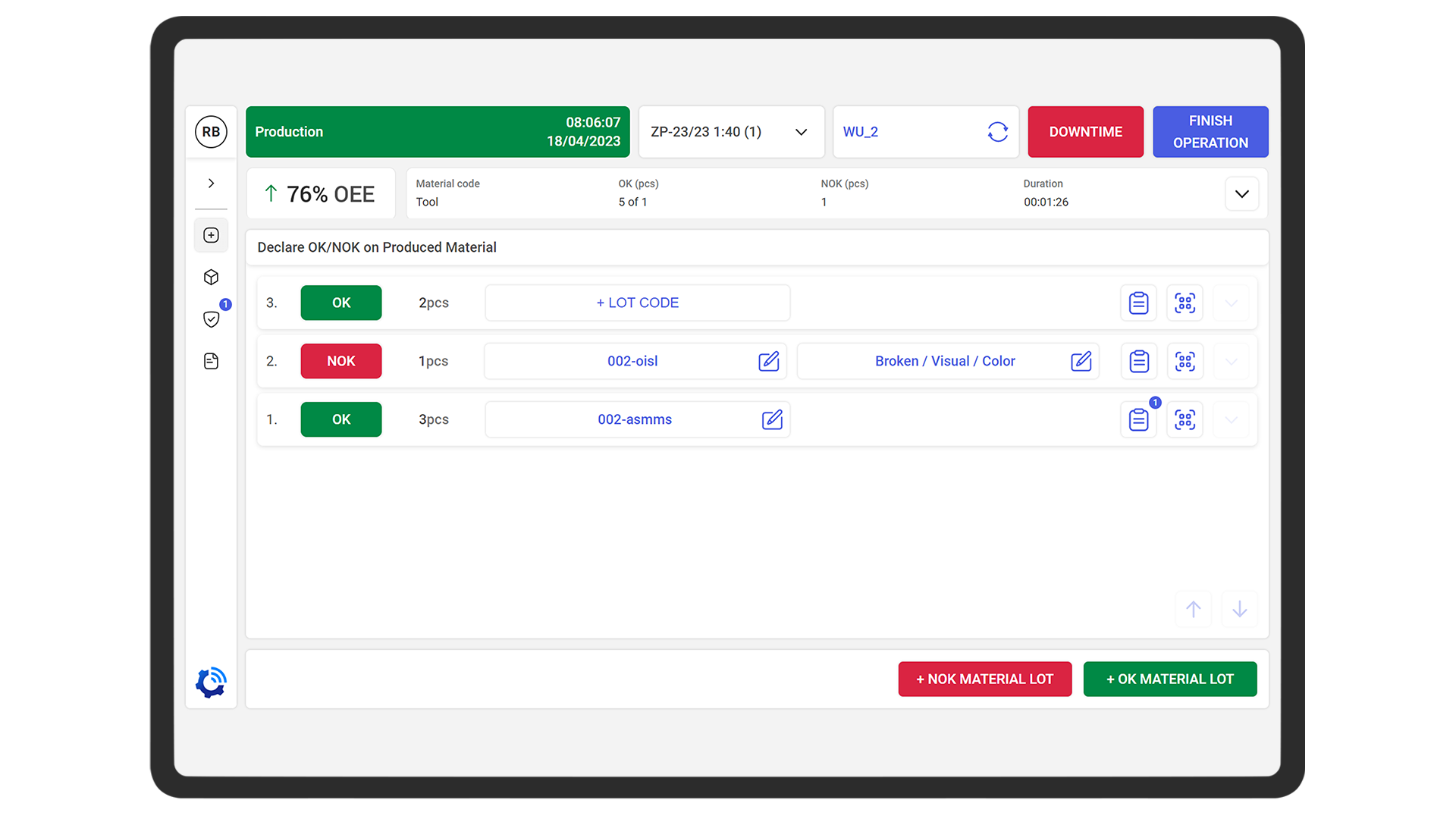
- User management
To sign in to the application, you can use a login and password or an access card. Access to individual machines is limited by an authorization system that automatically verifies and checks whether a machine’s operator has been provided with appropriate permissions and trained to work on a given workstation.
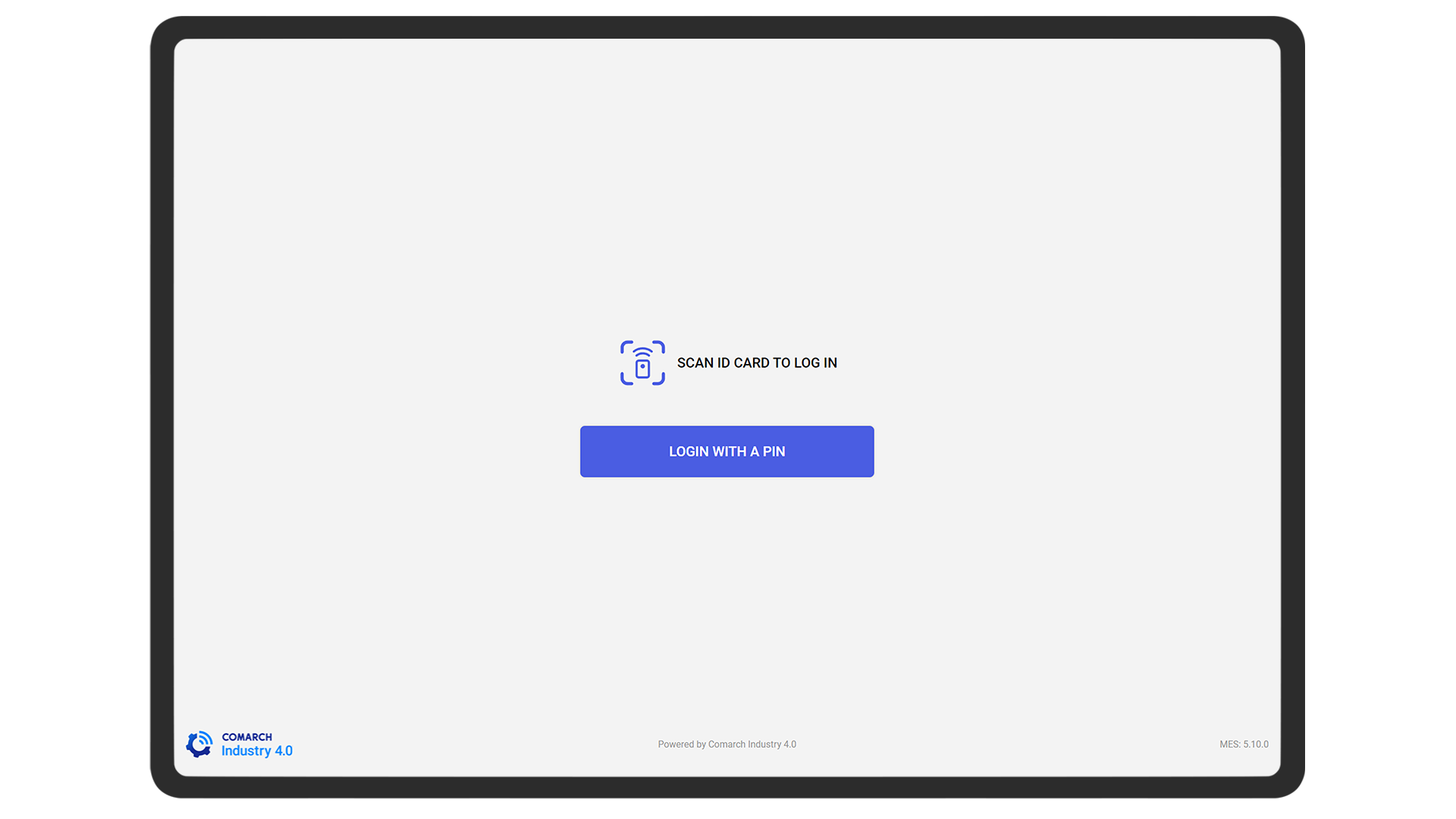
- Production orders
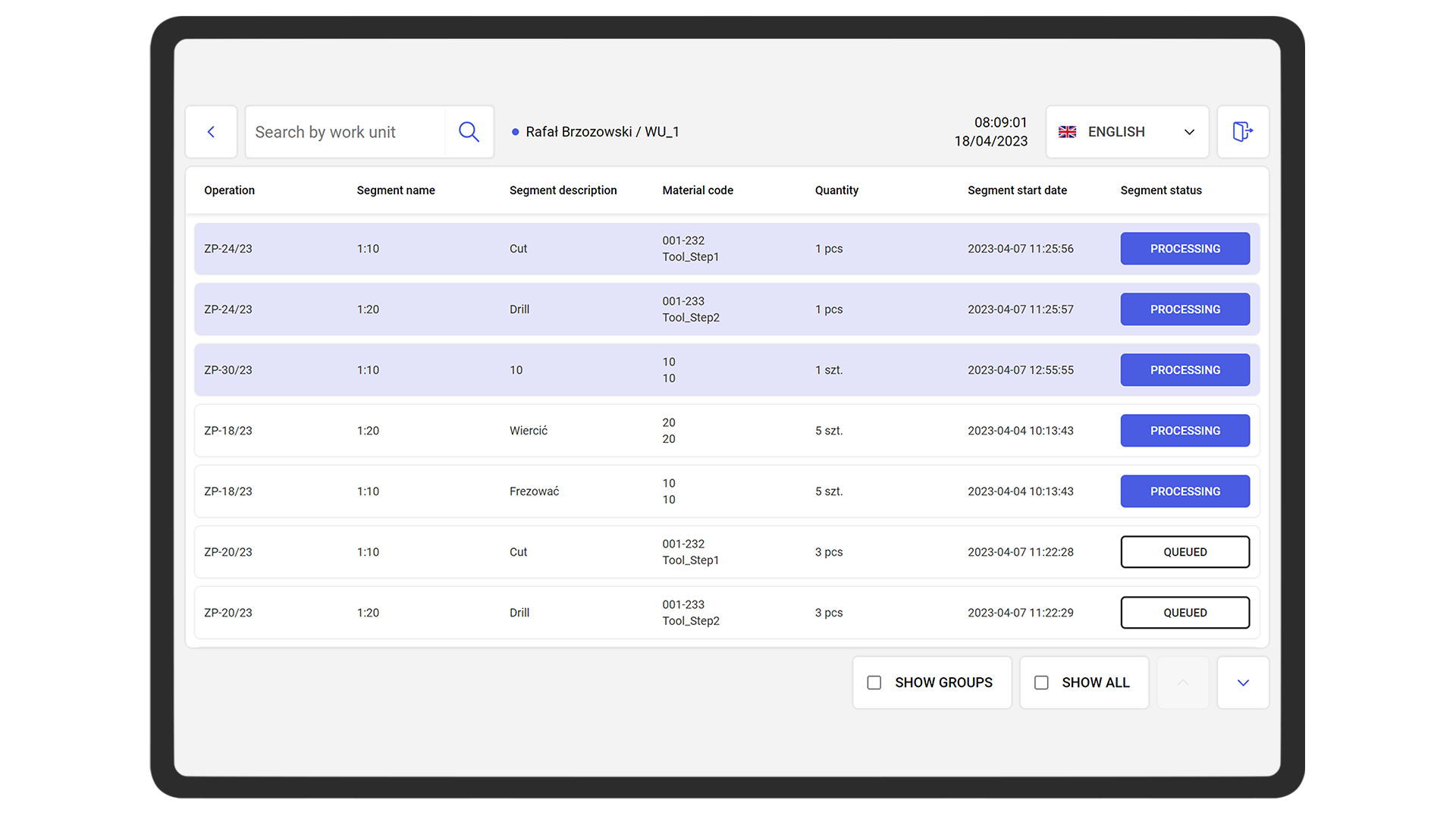
Thanks to digital data exchange, the operator can select a production order, prepared and planned especially for that operator, in the MES application panel. Before starting work, it is possible to check detailed information about a given order, such as the number of pieces to be made or the time of operation.
You can also decide whether to start a changeover or proceed directly to production. The operator independently selects the operation to be performed from among all operations assigned to the current workstation. The sequence of operations may be planned beforehand in external APS systems and presented as prompts to the user.
- Communication with machines
The system allows establishing a permanent connection with machines in order to read currently available signals (such as status and working time), emerging alerts, and information on the number of pieces produced. As a result, you receive reliable data on the status and execution of a production order in real time.
- Control of production materials
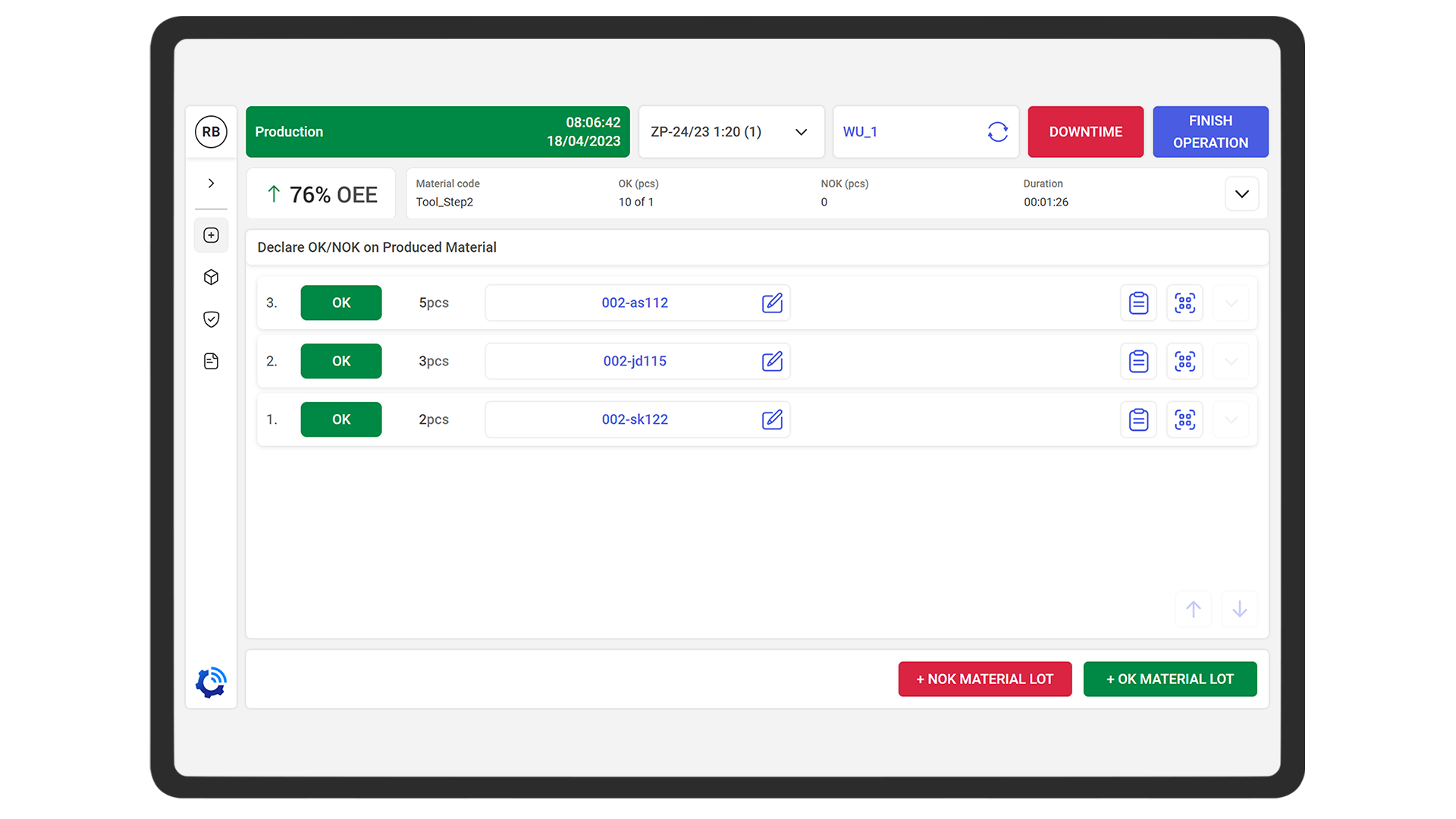
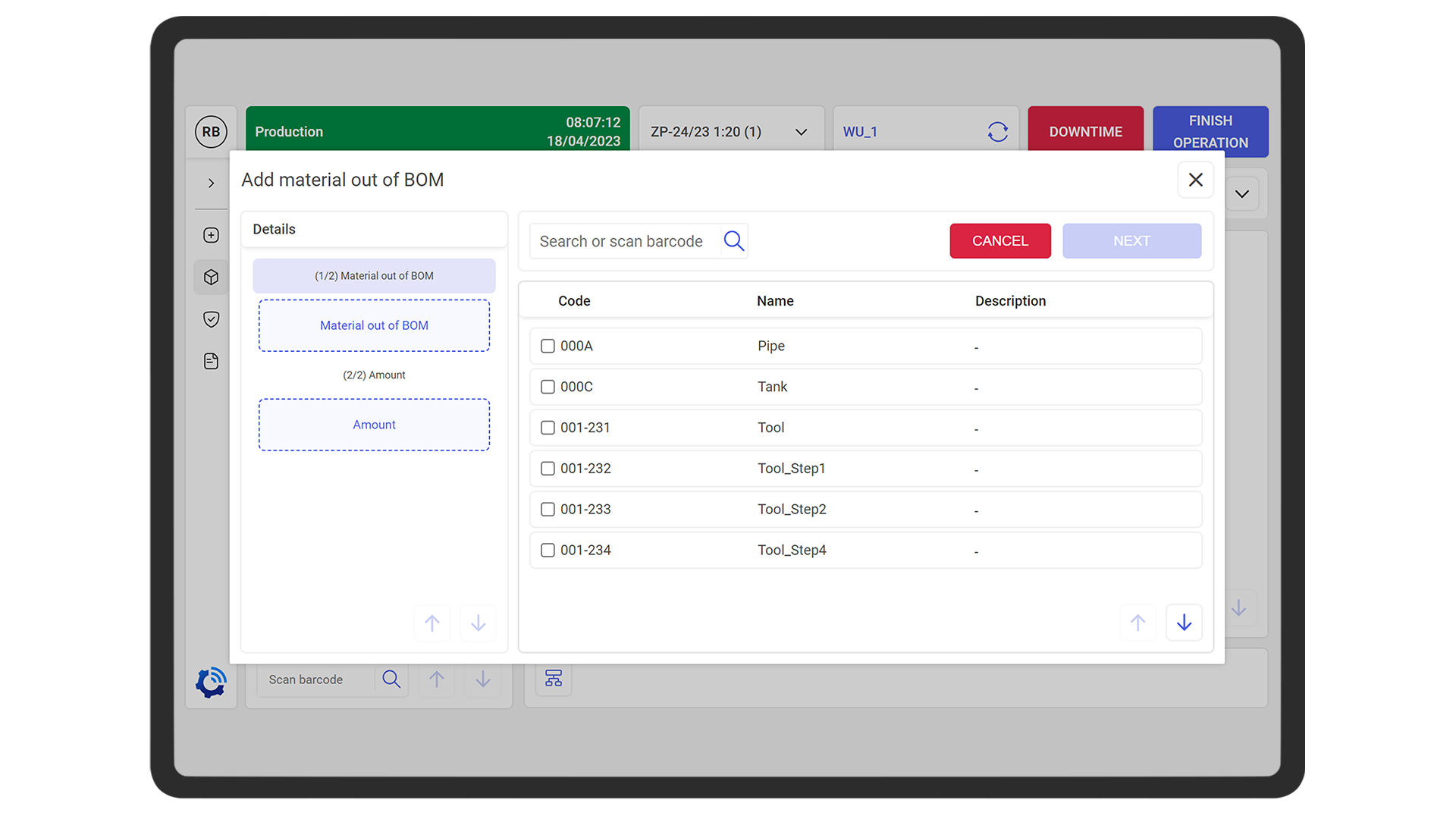
Integration with an ERP system allows the constant tracking and control of used materials. The quantity of manufactured goods is declared automatically (based on a signal from a machine) or manually, using the production panel.
The employee can view a bill of materials (BOM) assigned to a current operation and declare the utilization of individual materials and non-conforming goods. This makes it possible to monitor the quantity and quality of materials used.
- Quality control
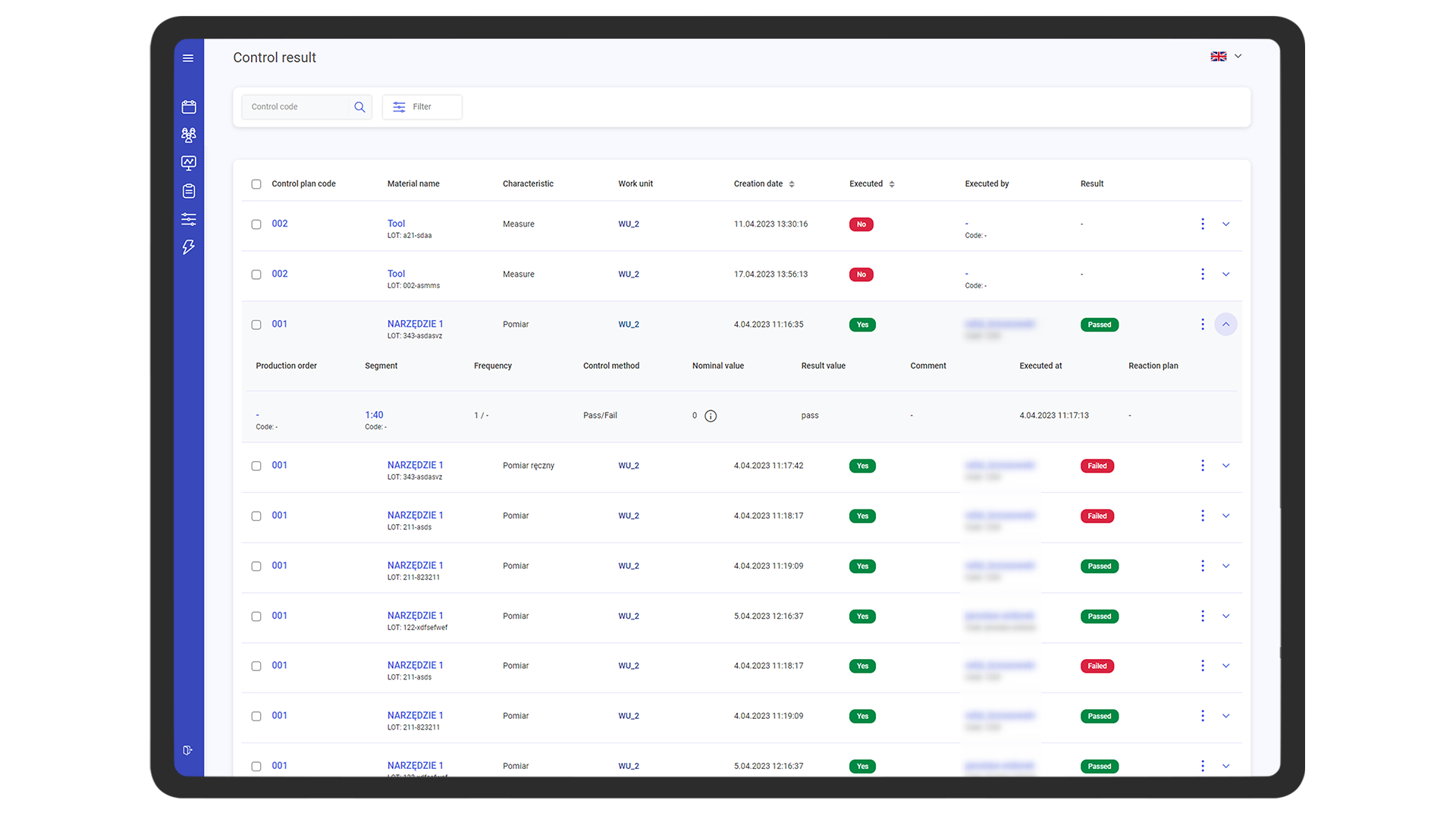
Quality control plans allow the ongoing monitoring of product quality, eliminating non-conforming products, which reduces production costs significantly. The integration of MES with QMS systems and the digitization of quality control plans make it possible to avoid creating piles of paper documentation, guiding the operator in a simple way through control and measurement activities.
Operators can press a button that automatically reads a measurement from a device that made it, with no need to perform the entire operation manually.
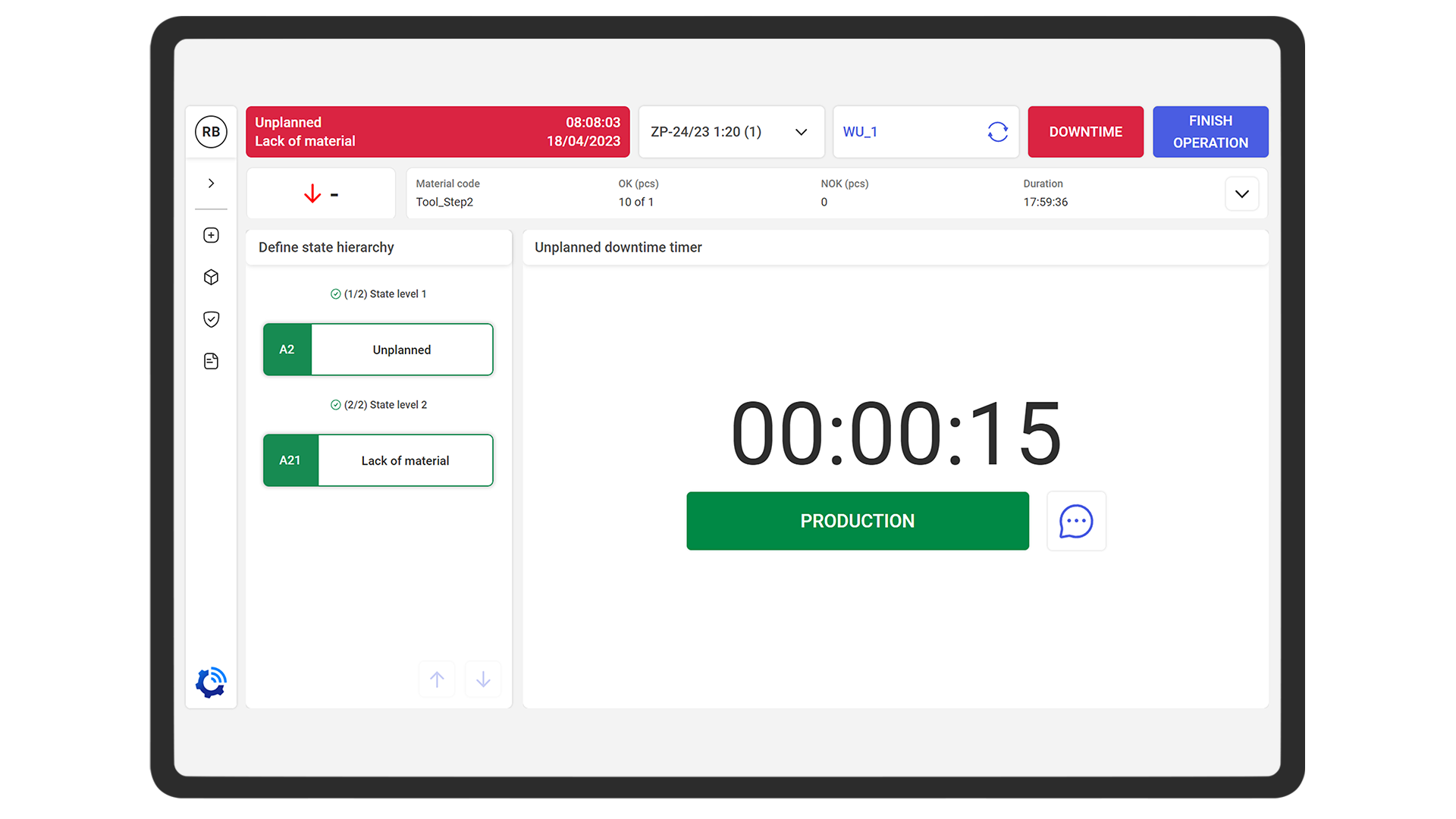
- Tracking downtime
Machine downtime can be registered automatically (based on a signal from a machine) or manually through an operator’s interaction with the system.
The operator can define the reason for a period of downtime and indicate whether it has been planned. The end of such a period may also be reported automatically or manually, and the entire event history is stored in the database.
- Maintenance
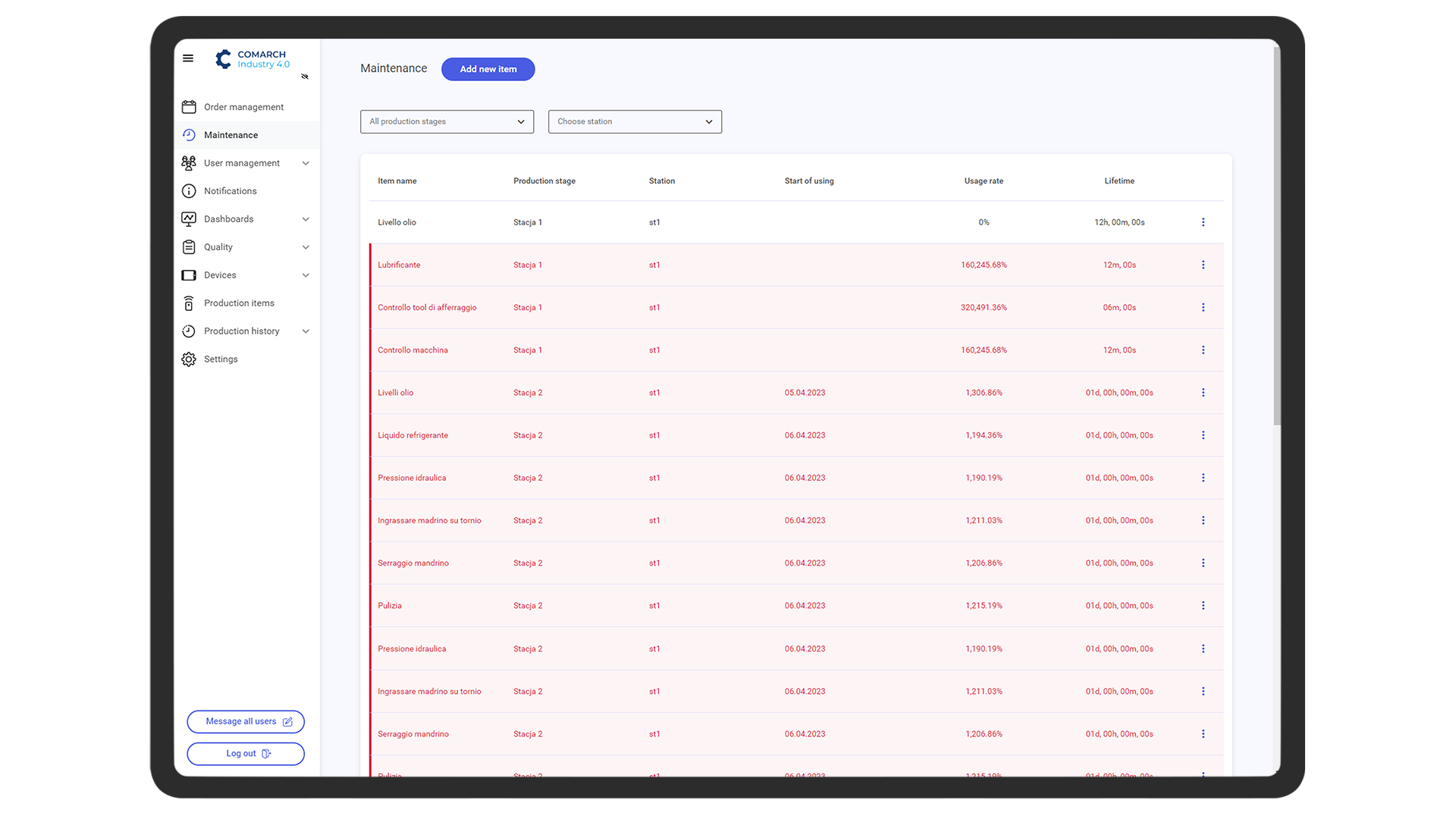
The maintenance module allows users to assign periodic service activities to each machine, specifying their time range and accordingly counting the employee-hours needed to perform them.
Information on the current status is available in the production panel and in the office part of the system. Employees are reminded of the need to perform service tasks by relevant notifications.
- Workplace instructions
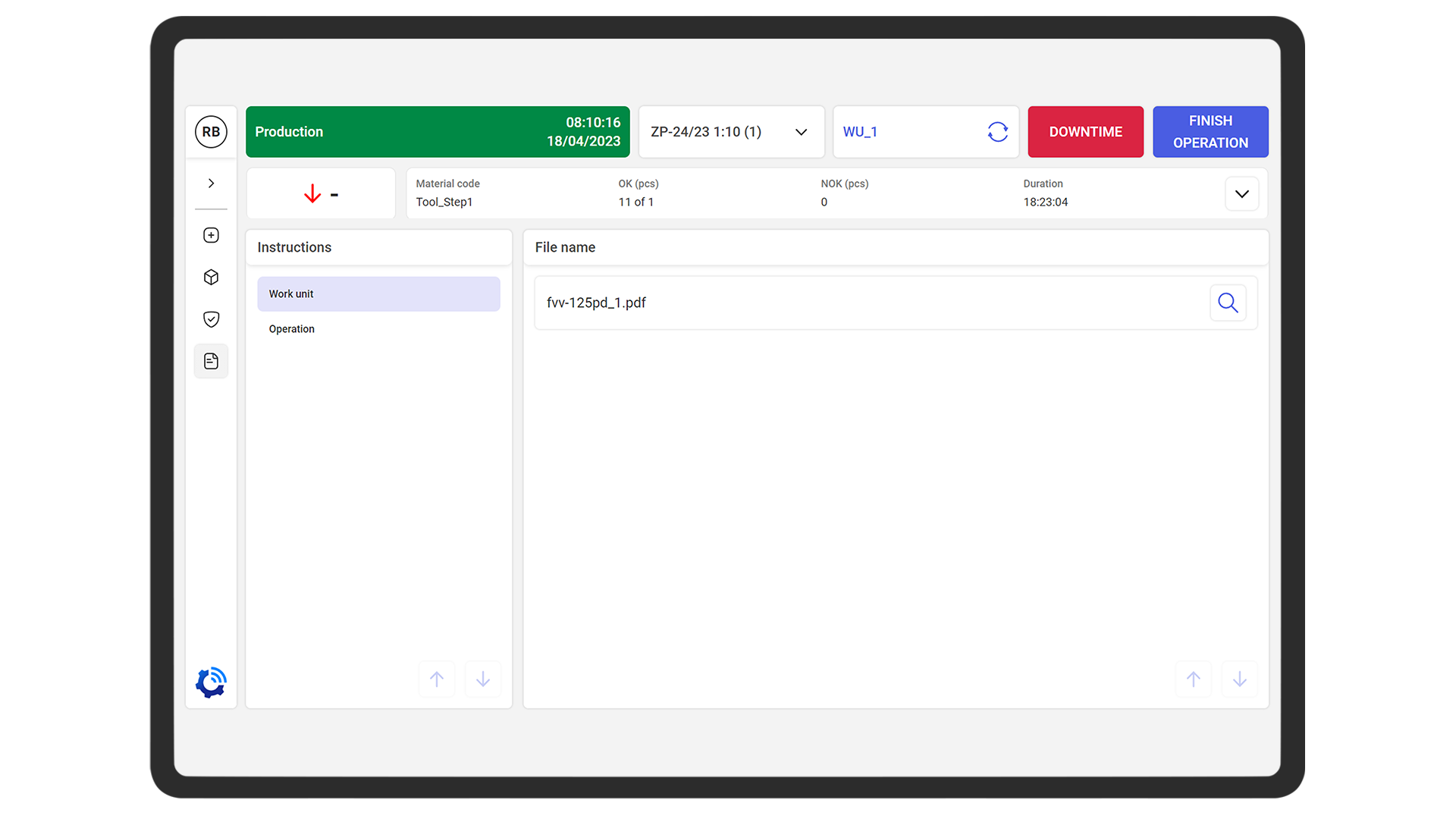
At any time, operators can view technical drawings, instruction files attached to a selected workstation or operation, technical documentation, and other attachments intended for employees in the application panel.