How to Scale IT Operations with Autonomous Agents vs. Chatbots
Most IT service desks are stuck in the “chat” era, where AI simply provides text-based answers that someone still has to manually act upon. Your team remains trapped in a loop of repetitive manual tickets while struggling with staffing shortages. It’s time to move beyond simple Generative AI toward Agentic AI – technology that talks and actually does the work.
What you will learn:
- Why simple chatbots are increasing your team's workload rather than reducing it.
- The leap from “giving advice” to “executing workflows.”
- How autonomous agents solve your chronic IT staffing and turnover issues.
- Why successful automation requires an expert partner, not just better software.
Why Today’s IT Chatbots Hit a Conversational Dead-End
Current Generative AI chatbots function largely as smarter search bars that redirect users to knowledge base articles rather than resolving underlying technical issues. This approach fails to scale, as it merely converts traditional ticket submissions into chat interactions, forcing IT teams to perform manual remediation. Consequently, many organizations struggle to realize actual ROI from their initial AI investments.
The current noise surrounding Generative AI often obscures its practical limitations. While chatbots can successfully retrieve documentation, they rarely fix the actual problem. For a CTO, this creates a ticket-to-chat conversion, where the IT team remains trapped in the manual labor of remediation.
Data confirms that these initial, surface-level deployments often struggle to deliver value. According to IBM, 29% of enterprises made AI-focused IT investments specifically to improve existing programs that did not perform as expected. This statistic validates the frustration many leaders feel: early AI deployments frequently fail to scale or address the root causes of operational friction.
Moving From Prompting to Performing: The Agentic Leap
The shift from Generative AI to Agentic AI represents the move from advisory chatbots to automated execution.
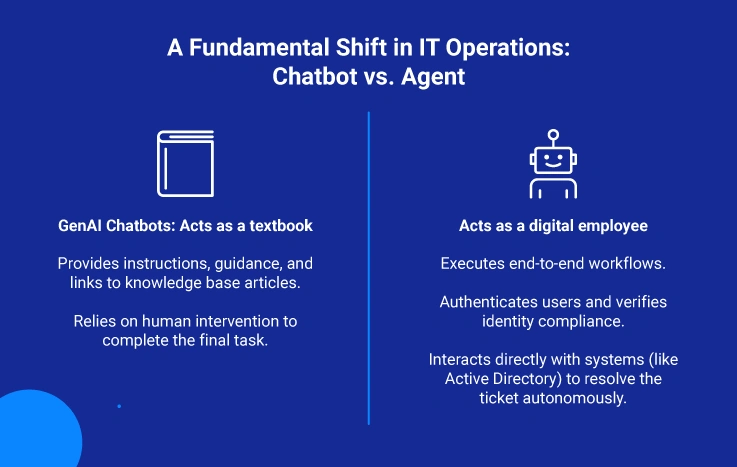
The distinction between a chatbot and an agent represents a fundamental shift in IT operations:
- GenAI Chatbots: Act as a textbook, providing users with instructions, guidance, and links to knowledge base articles. They rely on human intervention to complete the final task.
- Agentic AI: Acts as a digital employee, executing end-to-end workflows. It authenticates users, verifies identity compliance, and interacts directly with systems (like Active Directory) to resolve the ticket autonomously.
By deploying autonomous agents that execute remediation workflows (such as authenticating users and updating IAM systems), organizations can resolve recurring IT issues without human intervention, ensuring 24/7 operational efficiency.
For CTOs, the prospect of full-scale autonomy can feel daunting, but it does not require an all-at-once, enterprise-wide overhaul.
The data suggests that tactical implementation is highly effective. According to the same article by IBM, 92% of organizations observe operational improvements even when handing less than 10% of their ITOps duties to AI.
You do not need to automate everything at once to see ROI. Focusing on high-volume, low-complexity tasks provides immediate wins while proving the model's value.
Solving the IT Staffing Crisis: Manual Tickets & Digital Employees
Autonomous agents handle routine IT tasks (such as password resets, access provisioning, and server checks) without the churn, onboarding costs, or skill gaps of human staff. By offloading these repetitive functions to agents, manufacturing organizations can realign their best human talent toward revenue-driving strategic projects.
Your most valuable technical staff should be innovating on the manufacturing systems that drive your revenue, not performing manual remediation on Tier 1 and Tier 2 tickets. When skilled engineers are buried in routine maintenance, your IT department transforms from a strategic engine into an operational bottleneck.
Autonomous agents do not quit, they do not require training, and they do not have turnover costs. IBM claims that 53% of organizations say agents already handle at least a quarter of their ITOps tasks autonomously.
Leading organizations are now adopting hybrid agentic models, where autonomous agents manage the high-volume noise, while human staff focus on complex architecture and security. Successfully operating this hybrid structure is why many companies are looking to partner with managed service experts to optimize their service desk infrastructure.
Why Plug-and-Play AI Fails to Scale
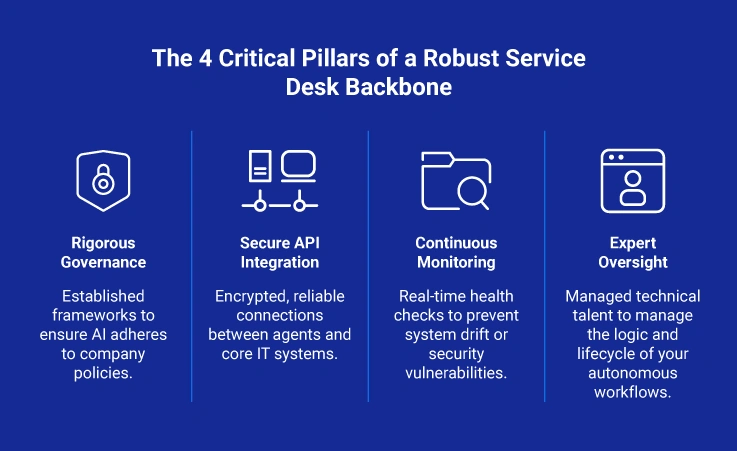
Automation is not a set-it-and-forget-it feature. A robust service desk backbone requires four critical pillars to function at scale:
- Rigorous Governance: Established frameworks to ensure AI adheres to company policies.
- Secure API Integration: Encrypted, reliable connections between agents and core IT systems.
- Continuous Monitoring: Real-time health checks to prevent system drift or security vulnerabilities.
- Expert Oversight: Managed technical talent to manage the logic and lifecycle of your autonomous workflows.
Even the most advanced AI agent will eventually drift or create security vulnerabilities if it is not supported by a solid foundation. Organizations often treat AI as a plug-and-play software add-on, but without established governance frameworks and secure API management, the result is fragmented, insecure operations.
To succeed, you need a sophisticated service desk backbone that manages the logic, security, and real-time health of your autonomous agents.
The primary hurdle for most enterprises is not the technology. It is the human capital required to run it. According to IBM’s research, more than a third of IT leaders cite a “lack of skilled personnel” as a major barrier to implementing AI-driven workflows at scale. This gap leaves your internal teams trapped in a cycle of maintenance, unable to build the future.
Comarch ICT bridges this disconnect by providing the dedicated expertise to design, govern, and monitor these workflows, acting as the stable backbone that allows your business to scale AI safely and efficiently.
Transforming Your Service Desk Into a Strategic Asset
The future of the IT service desk is defined by action. Transitioning to an autonomous model shifts your department from a cost center burdened by turnover to a strategic engine for the business. By leveraging agentic AI and professional service orchestration, you can reduce manual friction and empower your team to focus on high-value initiatives.
True operational maturity requires moving beyond simple ticket-processing to a model that integrates AI governance with human expertise, ensuring your infrastructure is built to scale safely.
Ready to make the shift?
Transitioning to an autonomous model is the primary goal. Organizations that thrive in this shift are those that treat their service desk not as a ticket-processor, but as a dynamic orchestration layer, often supported by managed partners who understand the intersection of AI governance and IT operations. Speak with an expert today to explore Comarch’s Service Desk solutions.