How Does AI Hyper-Personalization Improve the Customer Experience?
- PublishedLast update
- 7 min reading

In a market where 65% of global customers now demand individual offers, recommendations, and discounts from loyalty programs, standard personalization is no longer sufficient for retention. As revealed in the Comarch report, today’s consumers expect brands to move beyond generic segments and toward true hyper-personalization. By leveraging AI-driven data and real-time behavioral insights, companies can start building deeper, more emotional connections with consumers.
What Is Hyper-Personalization?
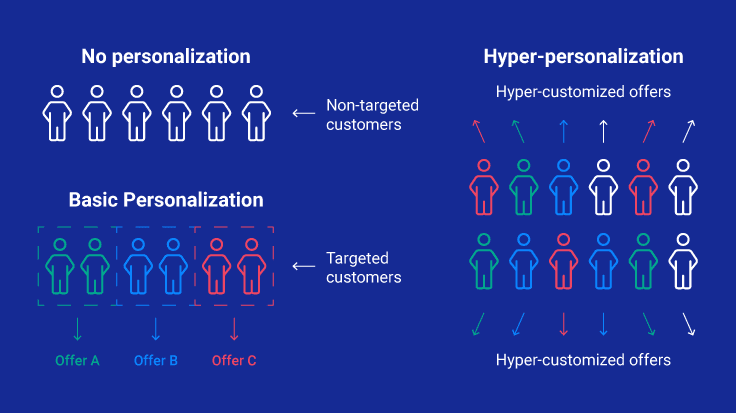
Hyper-personalization is an advanced marketing strategy that leverages Artificial Intelligence (AI) and real-time data to deliver highly individualized customer experiences.
Unlike traditional personalization, which relies on broad segments, hyper-personalization uses machine learning to analyze specific behavioral context, allowing brands to automate unique interactions for every individual recipient across all digital touchpoints.
Why Is Hyper-Personalization Important for Modern Brands?
By shifting from generic messaging to individual engagement, businesses can move beyond program fatigue. The strategic implementation of hyper-personalization offers three primary advantages for customer-centric organizations:
- Increased Basket Value: Our research shows that 55,78% of customers are more likely to shop more when a company offers a tailored experience.
- Higher Customer Lifetime Value (CLV): Tailoring offers to individual preferences builds the long-term trust required to reduce churn.
- Customer Appeal: According to McKinsey, consumers expect personalized offers and even get frustrated when it doesn’t happen.
What Is the Difference Between Hyper-Personalization and Traditional Personalization?
The primary difference lies in data depth and delivery speed: traditional personalization uses static historical data (like names or past purchases) to group users into broad segments, whereas hyper-personalization utilizes AI and real-time behavioral data to create unique, one-to-one experiences. This evolution allows brands to transition from reactive marketing to predictive engagement, significantly reducing program fatigue among loyalty members.
Comparing Traditional vs. Hyper-Personalization
- Data Granularity: Traditional methods rely on basic CRM fields. In contrast, hyper-personalization leverages predictive analytics and AI-driven data management to analyze subtle behavioral patterns, such as browsing intent and micro-interactions.
- Temporal Relevance: Traditional personalization is often batch-processed and delayed. Hyper-personalization uses machine learning algorithms to adjust offers instantly, responding to a customer's current session behavior rather than last month’s data.
- Conversion and Loyalty Impact: While traditional methods provide a baseline lift, hyper-personalization drives higher customer lifetime value (CLV) by delivering precision-targeted rewards.
| Feature | Traditional Personalization | AI Hyper-Personalization |
| Data Source | Static (Name, Gender, Location) | Dynamic (Real-time behavior, Intent) |
| Segmentation | Broad Groups / Personas | Individualized (One-to-One) |
| Timing | Scheduled / Delayed | Instantaneous / Real-Time |
| Core Goal | General Relevance | Predictive Engagement & High Conversion |
How Do Businesses Implement AI Hyper-Personalization Across the Customer Journey?
Businesses implement hyper-personalization by integrating AI algorithms with real-time data streams to automate one-to-one interactions. This process moves beyond static segmentation by using predictive modeling to adjust content, pricing, and product recommendations instantly as a customer interacts with the brand. This ensures that every touchpoint (from initial discovery to long-term loyalty) is contextually relevant.
Acquisition and Conversion Tactics
To turn prospects into buyers, AI optimizes the first interaction by removing friction and increasing relevance:
- Hyper-Personalized Advertising: Algorithms analyze browsing intent to serve ads tailored to a user’s specific immediate needs rather than broad demographics.
- Dynamic Landing Pages: Websites use real-time data to rearrange content, hero images, and offers so each visitor sees the products most relevant to their profile.
- Pre-Populated Applications: To combat the “long joining process” barrier (cited as a top enrollment obstacle in the Comarch 2025 Loyalty Predictions), AI pre-fills forms with known customer data to maximize conversion speed.
Engagement and Real-Time Experience
Once a customer is on-site or in-app, AI manages the live experience to drive immediate action:
- AI Recommendation Engines: These provide one-to-one product suggestions based on micro-interactions, significantly increasing the likelihood of purchase.
- Dynamic Pricing and Promotions: AI algorithms adjust discounts and price points in real-time based on individual price sensitivity and behavioral triggers.
- Real-Time Product Alerts: Automated triggers send notifications (like “back in stock” or price drops) at the exact moment a customer is most likely to convert.
Retention and Loyalty Building
For long-term growth, hyper-personalization ensures customers feel like individual partners:
- Omnichannel Personalization: This ensures a consistent brand experience by integrating customer data across all channels, from mobile apps to in-store POS.
- Hyper-Personalized Communications: AI-driven emails and messages utilize dynamic images and videos that change based on the recipient's latest activity.
- Automated Re-engagement: Predictive modeling identifies customers at risk of churn and triggers personalized win-back offers to recapture lost business opportunities.
What Are the Benefits and Challenges of AI Hyper-Personalization?
The primary benefits of hyper-personalization include an increase in revenue and significantly lower return rates, driven by high-relevance impulse purchases. However, the strategy faces significant challenges in data privacy and content quality. Success requires a human-in-the-loop approach where AI manages data analysis while human specialists ensure brand voice authenticity.
Key Business Benefits of Hyper-Personalization
- Reduced Resource Waste: By automating one-to-one relevance, companies eliminate spend on generic, low-conversion campaigns.
- Minimized Churn: AI predicts potential loyalty fatigue and triggers win-back offers before a customer leaves.
- Operational Efficiency: Utilizing a loyalty marketing platform allows for the centralized management of these complex data streams.
Critical Implementation Challenges
- The Privacy Paradox: While customers want personalization, they are increasingly sensitive to how data is handled. Brands must balance predictive power with transparent data compliance (GDPR/CCPA) to avoid making customers feel tracked.
- The “Uncanny Valley” of AI Content: Content generated solely by AI can feel unnatural. To maintain high engagement, AI should be used for distribution and logic, while human specialists develop the creative messaging.
- Data Silos: Effective hyper-personalization is impossible without high-quality, integrated data. Fragmented systems often lead to improperly personalized experiences that can damage brand trust.
How Do Leading Brands Apply AI Hyper-Personalization? (Real-World Case Studies)
Retail & Beauty: Alshaya Group (Aura) – Unified Loyalty Ecosystems
The Alshaya Group partnered with Comarch to create the Aura program, a massive loyalty ecosystem spanning over 50 international brands, such as Victoria’s Secret, H&M, and Starbucks. By integrating disparate data points into a single strategy, the program leverages AI to provide a seamless, individualized experience across diverse sectors like fashion, food, and pharmacy. A customer’s unique value is recognized across the entire brand portfolio, rather than in isolated silos.
Retail: The Foschini Group (TFG Rewards) – Agentic Campaign Management
TFG Rewards operates a unified multi-brand ecosystem for 15.2 million members across 26 retail brands, powered by a centralized data lake of 2 billion points. In a 2025 industry first, TFG transitioned to agentic campaign management, utilizing collaborating AI agents to manage the nuances of multi-brand communication. This approach ensures every interaction is grounded in historical performance and personalized to a member's specific style affinity.
Aviation: Azul Airlines (TudoAzul) – Scaling to 20 Million Members
Azul Airlines utilized the Comarch Loyalty Management platform to scale its TudoAzul program to over 20 million loyal members. By implementing AI-driven automation, Azul can process vast amounts of flight and behavioral data to deliver right-time offers to travelers. This hyper-personalized approach to the travel journey ensures that promotions for seat upgrades, partner rewards, and point redemptions are tailored to the specific travel patterns and preferences of each individual member.
Travel: Heathrow Airport – Real-Time Passenger Engagement
Heathrow Airport uses Comarch technology to transform the passenger experience from a generic transit point into a personalized retail and service journey. By analyzing real-time data from millions of annual travelers, Heathrow delivers hyper-personalized notifications and offers that correspond to a passenger's location and dwell time within the terminal. This localized, real-time engagement increases airport retail revenue while significantly improving the overall traveler satisfaction score.
How Is Hyper-Personalization Applied Across Different Industries?
Financial Services and Banking
Instead of generic credit offers, AI analyzes spending patterns to provide personalized financial advice and product designs tailored to a user’s current life stage (e.g., mortgage suggestions exactly when a customer begins house-hunting). This predictive approach transforms the bank from a transaction processor into a proactive financial partner.
Grocery Retail
Hyper-personalization in grocery retail focuses on “relevance over volume.” By leveraging historical purchase data, supermarkets can provide individualized digital circulars and coupons for products the customer actually consumes.
Fuel Retail and Convenience
Hyper-personalization uses location-based triggers and purchase history to send real-time notifications for fuel discounts or in-store coffee offers at the exact moment a driver is near a station
Insurance: Using AI-driven data management, insurers can offer personalized premiums based on real-time behavior (such as telematics in auto insurance) or provide timely lifestyle guidelines that help policyholders maintain their health, ultimately reducing claim frequency and building deeper trust.
Telecommunications
By monitoring data usage patterns and contract expiration dates, AI agents can trigger individualized plan upgrades or loyalty add-ons (like extra data or streaming subscriptions) specifically tailored to the user's consumption habits.
Automotive
Brands use vehicle diagnostic data and driving behavior to send predictive maintenance alerts and individualized service offers. This creates a continuous loop of engagement where the vehicle itself becomes a touchpoint for personalized ecosystem rewards.
How to Transition from Traditional to Hyper-Personalized Loyalty Programs
Standard personalization is no longer enough to win the hearts—or wallets—of today’s consumers. To stay top-of-mind, your brand needs a platform that transforms complex data into immediate, individualized value.
Discover how Comarch’s award-winning Loyalty Marketing Platform can help you automate engagement and drive measurable growth.
Want to dive deeper into the technology? Explore the specific role of AI in Loyalty to see how our agentic campaign management and predictive modeling can revolutionize your customer journeys.